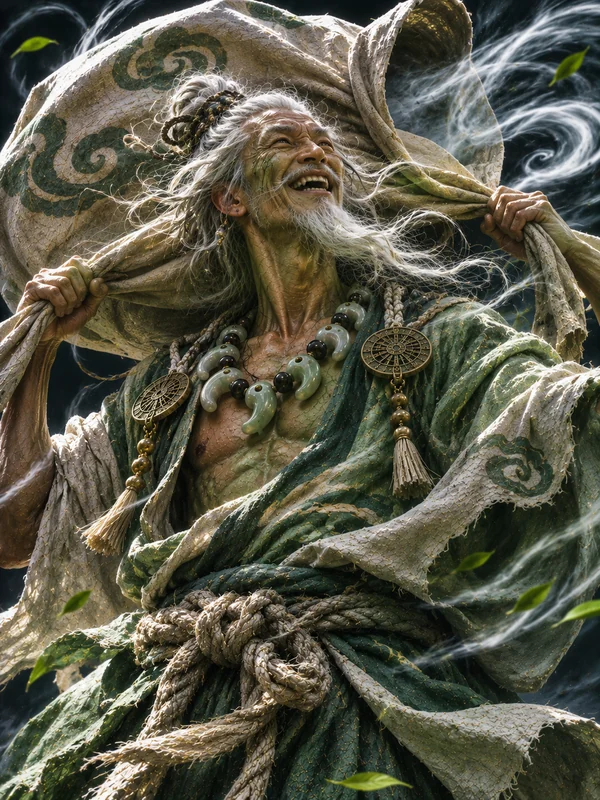
Fūjin
God of the wind
“One breath, and the mist was gone”
AT A GLANCE
- JAPANESE
- 風神 (Fūjin)
- DOMAIN
- Wind, storms, typhoons
- PARENTS
- Izanagi and Izanami
- SYMBOLS
- Bag of winds
- HOME
- The open sky
KEY MYTH
In the Kojiki the wind god Shinatsuhiko is born to Izanagi and Izanami; in one Nihon Shoki version he is Izanagi's own breath, which blew the morning mist off the new land. The storms that wrecked the Mongol fleets in 1274 and 1281 were called kamikaze, the divine winds.
TITLES AND EPITHETS
Shinatsuhiko
“Prince of the long breath”, his name in the Kojiki
Kaze-no-Kami
“God of the wind”, the plain title
STORY
Born with the world
In the Kojiki the wind god Shinatsuhiko is one of the many kami born to Izanagi and Izanami after the islands, together with the gods of trees, mountains and plains.
The breath that cleared the mist
One version in the Nihon Shoki tells it differently: when the newly born land lay hidden in morning mist, Izanagi blew it away, and his breath became the wind god.
The divine winds
In 1274 and again in 1281 great Mongol fleets sailed against Japan, and both times storms wrecked them. People called the storms kamikaze, “divine winds”, and the wind shrines at Ise were raised in rank in thanks.
The demon with a bag
The Fūjin of later art is a green-skinned, grinning figure holding a great bag of winds over his head. Art historians trace that bag back along the Silk Road through Central Asian wind gods, some as far as the Greek Boreas.
POWERS
Wind
From breeze to typhoon, every wind is his breath.
Clearing
His first deed was to blow away the mist so the land could be seen.
Storms at sea
The winds that sank the Mongol fleets were credited to the wind gods.
WORSHIP
Tatsuta Taisha, Nara
The Nihon Shoki records Emperor Tenmu sending envoys to worship the wind gods at Tatsuta in 675. The shrine still holds a wind festival to protect the harvest from storms.
Kaze-no-Miya, Ise
Small shrines to the wind gods at the Ise Grand Shrine were given the title “Wind Palace” after the Mongol invasions.
LEGACY TODAY
Kamikaze
The word for the divine winds of 1274 and 1281 passed into history, later for the suicide pilots of the Second World War.
Wind and thunder
Fūjin and Raijin almost always appear as a pair, guarding gates and filling Sōtatsu's famous folding screens.
DID YOU KNOW
Fūjin's bag is said to hold all the winds of the world; he only loosens it a little at a time.
His green skin and Raijin's red or pale skin are a fixed colour pair in Japanese art.
The Kojiki also names a wind goddess, Shinatobe; some texts treat them as a pair.
FAMILY
- Parents
- Izanagi, Izanami