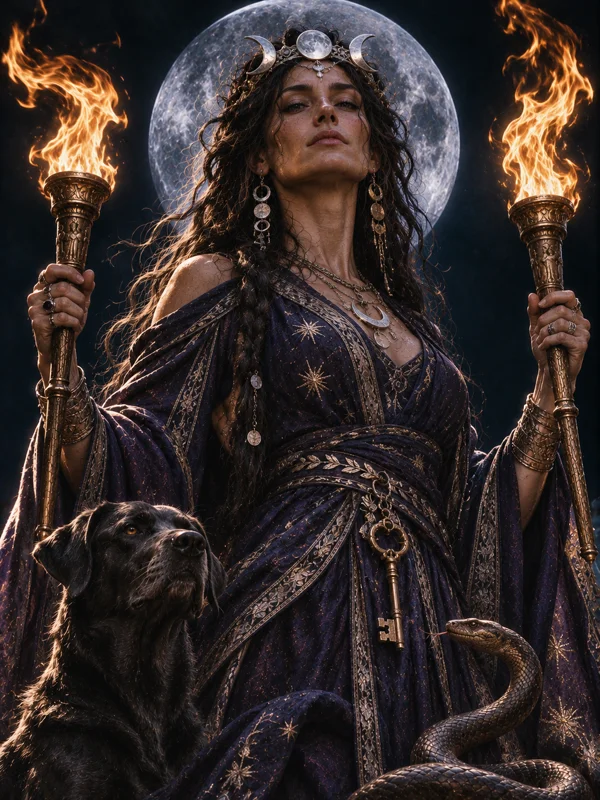
Hecate
Goddess of crossroads and magic
“Honoured by Zeus above all others, in Hesiod's words”
AT A GLANCE
- ROMAN
- Trivia (merged with Diana)
- DOMAIN
- Crossroads, magic, night, ghosts, torches
- PARENTS
- The Titans Perses and Asteria (in Hesiod)
- SYMBOLS
- Two torches, keys, dogs
- HOME
- Crossroads; the underworld, at Persephone's side
KEY MYTH
When Hades carried off Persephone, only Hecate and the Sun heard her scream. Hecate met the grieving Demeter with a torch in her hand and went with her to ask the Sun what had happened. When Persephone came back, Hecate became her constant companion.
TITLES AND EPITHETS
Phosphoros
“Light-bringer”, the torch-bearer
Trioditis
“Of the three ways”, goddess of the crossroads; in Latin, Trivia
Propylaia
“Before the gate”, guardian of doorways
Kourotrophos
“Nurse of the young”, a title Hesiod gives her
STORY
Daughter of the Titans
Hecate was the only child of the Titans Perses and Asteria. When Zeus took power he did not strip her of the honours she had held under the Titans. He let her keep a share of the earth, the sea and the starry sky.
Hesiod's hymn
Hesiod praises her at length: she brings victory in war and in court, luck to riders, athletes, fishermen and herdsmen, and she cares for the young. Whoever made a sacrifice, he says, called on Hecate.
She hears Persephone
When Hades seized Persephone, only Hecate in her cave and the Sun heard the girl cry out. On the tenth day of Demeter's search, Hecate met her with a torch in her hand, and the two goddesses went together to ask the Sun what he had seen.
Persephone's companion
When Persephone came back from the underworld, Hecate welcomed her with a warm embrace, and from then on she was Persephone's attendant and companion. That bond tied her to the world of the dead.
The war against the Giants
In Apollodorus, when the Giants attacked Olympus, Hecate fought beside the gods and killed the Giant Clytius with her torches.
Medea's goddess
In Apollonius's Argonautica, the princess Medea is Hecate's priestess. She tells Jason to sacrifice to Hecate at midnight. The goddess rises crowned with snakes and oak leaves, surrounded by torches and baying hounds of the underworld.
POWERS
Torches
She lights the way through darkness, on earth and below it.
Magic
Sorceresses such as Medea called on her for herbs, potions and spells.
Mistress of ghosts
She led the restless dead at night, and howling dogs announced her coming.
Guardian of thresholds
Doors, borders and crossroads, the places between one world and another, were hers to watch.
WORSHIP
Hecate's suppers
Each month at the new moon, Athenians left food for her at crossroads. Aristophanes jokes that the poor came and ate it.
Hekataia
Small statues or pillars of Hecate stood outside house doors to protect the home.
Lagina
Her most famous temple (Strabo) stood at Lagina in Caria, in today's Turkey. Inscriptions from the 2nd century BC onward record a yearly procession that carried her sacred key.
LEGACY TODAY
Macbeth
In Shakespeare's play, in scenes probably added by Thomas Middleton, she is the queen of witches who gives orders to the three Weird Sisters.
Modern witchcraft
Many modern pagans and witches honour her as a goddess of magic and the crossroads.
DID YOU KNOW
Pausanias believed the triple Hecate began with a statue by Alcamenes in Athens. Earlier art shows her with a single body.
Dogs were her sacred animals, and dogs were sometimes sacrificed to her.
Her Latin name Trivia comes from trivium, a place where three roads meet. The English word 'trivial' comes from the same root.
FAMILY
- Parents
- Perses, a Titan, Asteria, sister of Leto