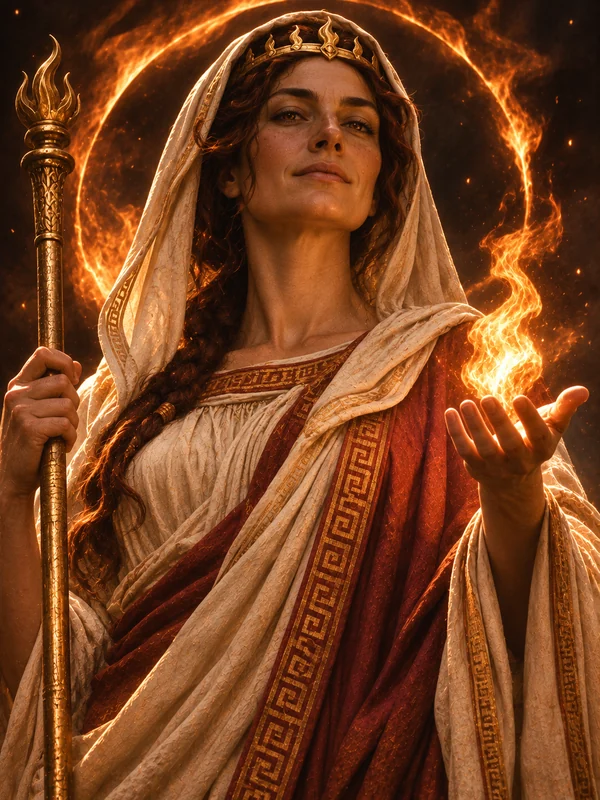
Hestia
Goddess of the hearth
“Every home begins with a fire”
AT A GLANCE
- ROMAN
- Vesta
- DOMAIN
- The hearth, home and family, the city's sacred fire
- PARENTS
- Kronos and Rhea
- SYMBOLS
- Hearth fire, veil, kettle
- HOME
- Every home and town hall
KEY MYTH
Eldest child of Kronos, she refused Poseidon and Apollo and swore to stay a maiden. Zeus gave her the centre of every house and the first share of every sacrifice.
TITLES AND EPITHETS
Eldest and youngest
First born of Kronos's children and the last he threw back up
Prytaneia
“Of the town hall”, keeper of the city's public hearth
STORY
Eldest and youngest
Hestia was the first child of Kronos and Rhea, and so the first one Kronos swallowed. When Zeus forced him to bring his children back up, she came out last. The Homeric Hymn to Aphrodite calls her both eldest and youngest for this reason.
The vow
Poseidon and Apollo both wanted to marry her. Hestia refused them, put her hand on Zeus's head and swore to stay a maiden forever. In return Zeus gave her the centre of every house and the first share of every sacrifice.
First and last
Because the hearth was where every offering began, Greeks gave Hestia the first portion of a sacrifice, and prayers and feasts often began and ended with her name.
The one who stays home
In Plato's Phaedrus, when the gods ride out across the heavens in their chariots, Hestia alone stays behind in the house of the gods.
POWERS
The hearth
The fire at the centre of every home and temple.
Home and family
Guest, host and household were under her protection.
The city's fire
Every Greek city kept her flame burning in its town hall.
WORSHIP
The prytaneion
Every city had a public hearth in its town hall. Colonists carried fire from their mother city's hearth to light the first fire of a new city.
Vesta in Rome
The Romans worshipped her as Vesta. Her priestesses, the Vestal Virgins, kept her fire burning in the Roman Forum for about a thousand years, until it was put out in 394 CE.
LEGACY TODAY
Hestia in Greek today
The word estia still means hearth and home in modern Greek, and it also means a centre or focus.
The quiet Olympian
She has almost no myths and very few images in Greek art, yet every household honoured her daily.
DID YOU KNOW
Her name simply means “hearth”.
The popular story that she gave her seat on Olympus to Dionysus is modern, from Robert Graves, not from any ancient source.
Oaths were sworn by Hestia, and a fugitive who sat at a house's hearth was under her protection.
FAMILY
- Parents
- Kronos, Rhea
- Siblings
- Zeus, Hera, Poseidon, Demeter, Hades