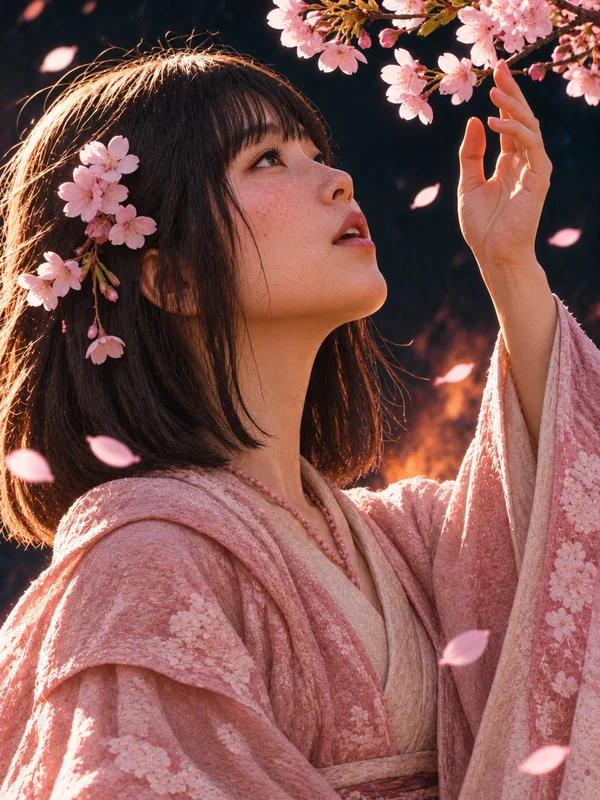
Konohanasakuya-hime
Goddess of blossoms and Mount Fuji
“Beautiful, and brief as the blossom”
AT A GLANCE
- JAPANESE
- 木花之佐久夜毘売 (Konohanasakuya-hime)
- DOMAIN
- Blossoms, Mount Fuji, childbirth, fire safety
- PARENTS
- Ōyamatsumi, god of mountains
- SYMBOLS
- Cherry blossoms, Mount Fuji
- HOME
- Mount Fuji
KEY MYTH
Amaterasu's grandson Ninigi married the blossom princess but sent back her sister, the rock princess, so the emperors' lives became brief as flowers. When he doubted her child, she gave birth inside a burning hut and came out unharmed with three sons. Later she was worshipped as the goddess of Mount Fuji.
TITLES AND EPITHETS
Konohanasakuya-hime
“Princess of the blossoming trees”
Kamuatatsu-hime
Another name for her in the Kojiki and Nihon Shoki
STORY
Two sisters
When Ninigi, grandson of Amaterasu, came down to earth, he met the beautiful Konohanasakuya-hime at Cape Kasasa. Her father, the mountain god Ōyamatsumi, gladly offered her and her elder sister Iwanaga-hime, princess of rock, together.
The choice of blossoms
Ninigi found Iwanaga-hime ugly and sent her home. Her father explained what he had lost: with the rock princess, the heavenly line would have lasted like stone; with the blossom princess alone, their lives would bloom and fall like flowers. That is why the emperors are mortal.
Birth in the fire
She became pregnant after one night, and Ninigi doubted the child was his. To prove it, she built a hut with no door, sealed it with clay and set it on fire as she gave birth. Unharmed in the flames, she bore three sons: Hoderi, Hosuseri and Hoori.
Goddess of Mount Fuji
In later centuries she was identified with the goddess of Mount Fuji, a volcano that blooms in spring and burns within. She is honoured at the Sengen shrines around the mountain and on its summit.
POWERS
Blossoms
Above all the cherry blossom, beautiful and short-lived.
Mount Fuji
Goddess of Japan's sacred volcano, asked to keep it calm.
Childbirth and fire safety
Because she gave birth unharmed in fire, she protects mothers and homes from fire.
WORSHIP
Fujisan Hongū Sengen Taisha, Shizuoka
The head of about 1,300 Sengen shrines, at the foot of Mount Fuji. The shrine also owns the top of the mountain above the eighth station.
Kirishima Shrine, Kagoshima
Near the mountain where Ninigi is said to have landed, the shrine honours him together with his wife.
LEGACY TODAY
The cherry blossom
Her story ties the sakura to the idea that beauty and life are brief, a theme found all through Japanese art and poetry.
Climbing Fuji
Pilgrims have climbed Mount Fuji for centuries to worship her, and the summit shrine still welcomes climbers each summer.
DID YOU KNOW
Her son Hoori is the hero who visits the sea god's palace, which makes her the great-grandmother of the first emperor in myth.
In the Nihon Shoki, Iwanaga-hime curses the human race to be short-lived like blossoms.
After a court case that lasted decades, the summit of Mount Fuji was formally handed over to her shrine in 2004.
FAMILY
- Parents
- Ōyamatsumi, great god of mountains
- Siblings
- Iwanaga-hime, princess of rock
- Consorts and lovers
- Ninigi, grandson of Amaterasu
- Children
- Hoderi, Hosuseri, Hoori, who visited the sea god's palace