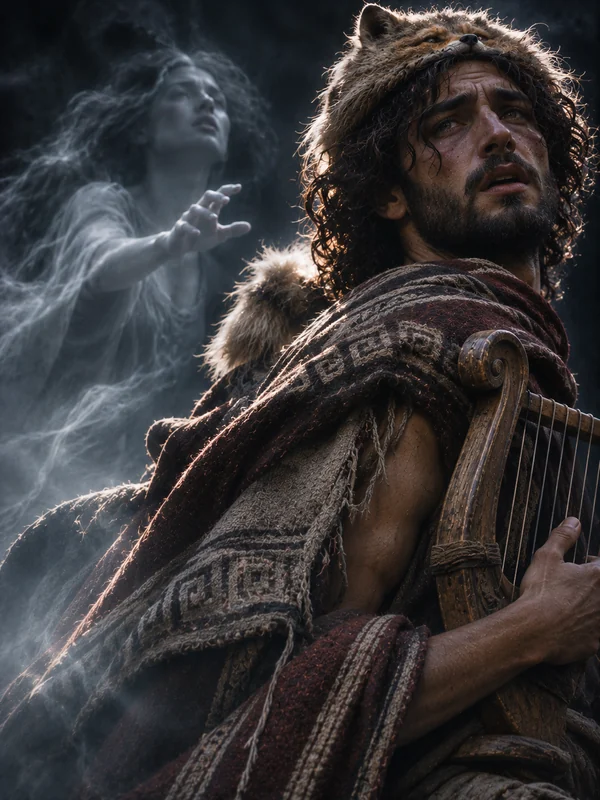
Orpheus
The singer who went down to death
“I sang, and even the stones listened”
AT A GLANCE
- ROMAN
- Orpheus
- DOMAIN
- Music, poetry, the mysteries
- PARENTS
- Oeagrus (or Apollo) and the Muse Calliope
- SYMBOLS
- Lyre, fox-skin cap
- HOME
- Thrace
KEY MYTH
His song moved stones, trees and even Hades. He won his dead wife Eurydice back, then lost her forever by looking back.
TITLES AND EPITHETS
Son of Calliope
Child of the Muse of epic poetry
The Thracian singer
From the wild north of the Greek world
STORY
The singer
Orpheus was the son of the Muse Calliope and the Thracian king Oeagrus (some said of Apollo). When he sang and played the lyre, wild animals followed him, trees moved closer and even stones listened.
Against the Sirens
He sailed with Jason on the Argo. When the ship passed the island of the Sirens, whose song lured sailors to their deaths, Orpheus played so loudly and beautifully that the crew heard him instead and sailed safely by.
Into the underworld
When his young wife Eurydice died of a snakebite, Orpheus went down to the land of the dead. His song moved even Hades and Persephone, and they let her go on one condition: he must not look back at her until they reached the daylight.
The look back
At the very edge of the upper world he turned to see if she was still there, and she slipped back into the darkness forever. This is the version of Virgil and Ovid; Plato says the gods only ever showed him a phantom of her.
The singing head
Later he was torn to pieces in Thrace by the Maenads, the wild women of Dionysus. His head floated down the river Hebrus still singing, and the waves carried it to the island of Lesbos.
POWERS
Music
His song could move animals, trees, stones and even the gods of death.
Passing into death
One of the few living people to enter the underworld and return.
Sacred knowledge
Later Greeks believed he founded secret rites that promised a better fate after death.
WORSHIP
The Orphic mysteries
Poems and rites under his name taught how the soul could escape the cycle of death and rebirth.
The oracle of the head
Later writers say his head gave prophecies in a shrine on Lesbos until Apollo silenced it.
LEGACY TODAY
Opera
Monteverdi's L'Orfeo (1607), one of the first operas ever written, and Gluck's Orfeo ed Euridice (1762) both tell his story.
Hadestown
The musical Hadestown, which retells his story, won the Tony Award for Best Musical in 2019.
DID YOU KNOW
In Plato's Symposium he is criticised for going down alive instead of being willing to die for his love.
Thin gold tablets found in Greek graves, linked to Orphic beliefs, tell the dead not to drink from the first spring they see in the underworld.
The constellation Lyra was said to be his lyre, set among the stars.
FAMILY
- Parents
- Oeagrus, king of Thrace (or Apollo, in some versions), Calliope, Muse of epic poetry
- Consorts and lovers
- Eurydice
ECHOES IN OTHER WORLDS
Izanagi (Japanese)
Each went down to the land of the dead to bring back his wife, broke the one rule about looking, and lost her. Orpheus turned round too soon; Izanagi lit a torch and saw Izanami rotting.