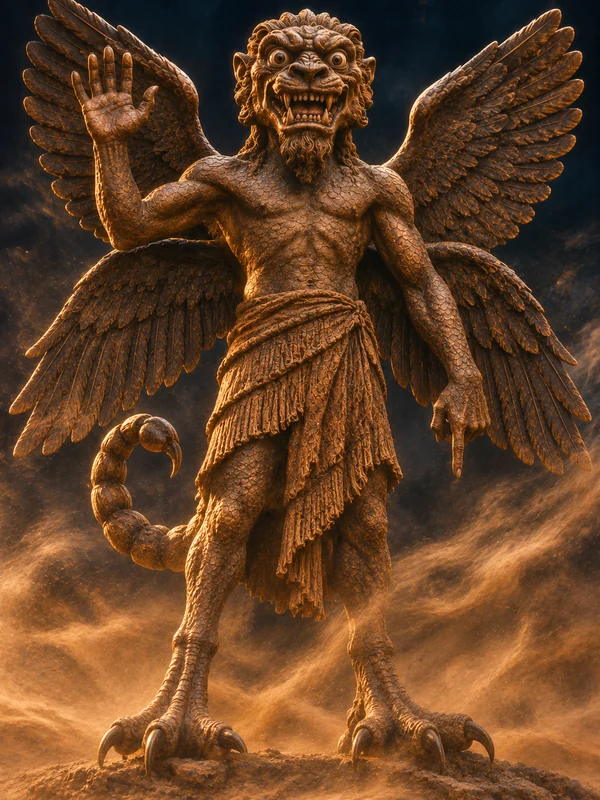
Pazuzu
King of the wind demons
“I am Pazuzu, son of Hanbi, king of the evil wind demons”
AT A GLANCE
- ANCIENT NAME
- Pazuzu (Akkadian)
- DOMAIN
- Hot winds, fever, protection against Lamashtu
- PARENTS
- Hanbi
- SYMBOLS
- Four wings, dog-like face, scorpion tail, raised hand
- HOME
- The scorching winds of the mountains and desert
KEY MYTH
A demon of fever-bringing winds, yet his image was hung over mothers and babies to scare away the even worse demoness Lamashtu.
TITLES AND EPITHETS
King of the wind demons
His own title on a famous bronze statuette now in the Louvre
Guardian of mothers
The demon people called on against a worse demon, Lamashtu
STORY
The burning wind
Pazuzu was the demon of the hot winds that swept in from the mountains and the desert, bringing fever, famine and locusts. His statuette says he went raging up the mountains and broke them.
Evil against evil
Lamashtu was the demoness who killed babies and mothers in childbirth. Only one being frightened her: Pazuzu. So people wore and hung up images of the demon himself to drive her away.
Sending Lamashtu away
Spells against Lamashtu gave her gifts for a journey, a comb, a spindle and sandals, loaded her onto a donkey and sent her off by boat. On the bronze Lamashtu plaques, Pazuzu's head peeks over the top and his claws grip the edge, watching her go.
POWERS
Winds and sickness
The scorching winds and the fevers they carried were his.
Protection
His image drove off Lamashtu and other demons.
Terror
His face alone was meant to frighten evil away.
WORSHIP
Amulets
In the first millennium BCE, Assyrians and Babylonians wore small Pazuzu heads of bronze, stone and clay, especially pregnant women and new mothers.
LEGACY TODAY
The Exorcist
In the 1973 film The Exorcist the demon is Pazuzu. The film opens at a dig in northern Iraq, where a priest finds a Pazuzu statue.
The Louvre statuette
A small bronze Pazuzu with its inscription on the back of the wings is one of the Louvre's best-known Mesopotamian objects.
DID YOU KNOW
He had a dog-like face, bulging eyes, four wings, eagle talons and a scorpion's tail.
His right hand points up and his left hand down in most statuettes.
He appears only in the first millennium BCE, very late in Mesopotamian history.
FAMILY
- Parents
- Hanbi, father of demons