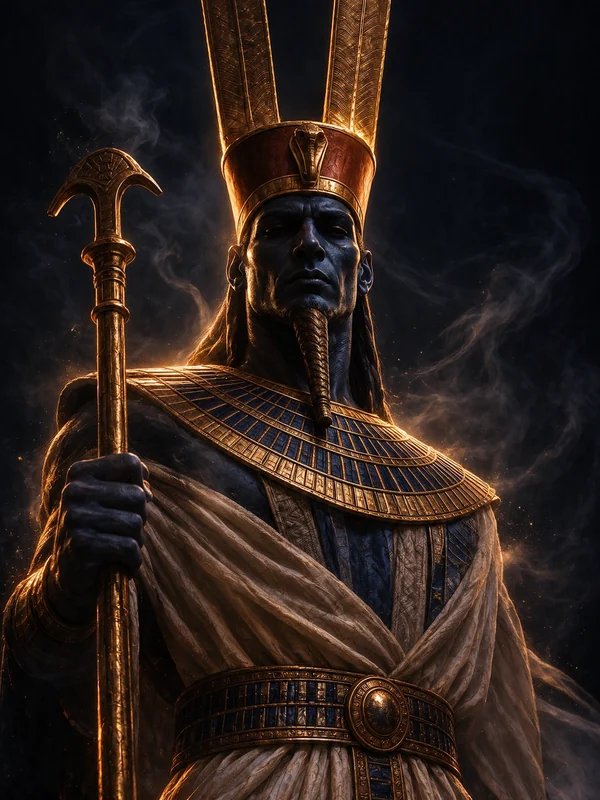
Amun
The hidden king of the gods
“You cannot see me, yet I am everywhere”
AT A GLANCE
- EGYPTIAN
- Imen
- DOMAIN
- Hidden power, air, kingship, oracles
- PARENTS
- None named: he was there from the beginning
- SYMBOLS
- Tall double plumes, ram, goose, blue skin
- HOME
- Thebes (Karnak)
KEY MYTH
Once a local god of Thebes, he became Amun-Ra, king of the gods, when Theban kings ruled Egypt. Akhenaten tried to erase him, but Tutankhamun brought him back.
TITLES AND EPITHETS
Amun-Ra
“Amun who is Ra”, king of the gods in the New Kingdom
Imen
“The hidden one”, the meaning of his name
STORY
The hidden one
Amun began as a god of Thebes and as one of the Eight, the primeval gods of Hermopolis, where he and his partner Amaunet stood for hiddenness. Like the wind, he could be felt but never seen.
King of the gods
When princes from Thebes reunited Egypt and later drove out the Hyksos around 1550 BCE, their god rose with them. Joined with the sun as Amun-Ra, he became king of the gods, and Karnak grew into the largest temple complex in Egypt.
The heretic king
Around 1350 BCE the pharaoh Akhenaten turned against Amun, closed his temples and had his name chiselled off monuments, worshipping only the sun disc Aten. After Akhenaten's death the young king Tutankhaten changed his name to Tutankhamun, “living image of Amun”, and the old god returned.
The oracle of Siwa
Far out in the western desert, at the oasis of Siwa, Amun spoke through an oracle that even the Greeks consulted. Alexander the Great went there in 331 BCE, and the priests greeted him as son of Amun. Coins later showed Alexander with Amun's ram horns.
POWERS
The hidden power
The unseen breath and wind that gives life to everything.
Kingship
Pharaohs of the New Kingdom called themselves his sons.
Oracles
His statue gave answers by moving as priests carried it.
WORSHIP
Karnak
Ipet-sut, “the most select of places”, was built and rebuilt for some 2,000 years. Its great hypostyle hall alone has 134 giant columns.
The Opet festival
Every year his statue was carried in a boat-shrine from Karnak to Luxor temple along an avenue of sphinxes, while Thebes celebrated for weeks.
LEGACY TODAY
Ammonites and ammonia
The fossil ammonites are named after the curled ram horns of Zeus-Ammon, and ammonia after the salts found near his temple in the Libyan desert.
Alexander's horns
Portraits of Alexander with ram horns spread his link to Amun across the Greek world.
DID YOU KNOW
He is often painted with blue skin, the colour of the air and the sky.
His sacred animals were the ram and the goose.
The word “amen” at the end of prayers is Hebrew and has nothing to do with Amun, despite a popular claim.
FAMILY
- Consorts and lovers
- Mut, mother goddess of Thebes
- Children
- Khonsu, the moon god of Thebes
ECHOES IN OTHER WORLDS
Zeus (Greek)
The Greeks worshipped Amun as Zeus Ammon. In 331 BCE Alexander the Great crossed the desert to his oracle at Siwa and was greeted as the son of Zeus-Ammon.