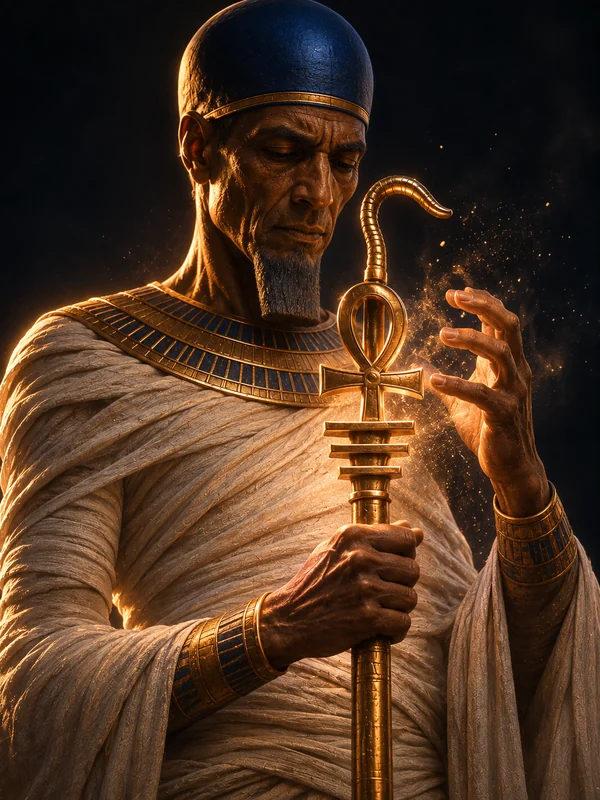
Ptah
The creator by word
“I thought the world in my heart and spoke it with my tongue”
AT A GLANCE
- EGYPTIAN
- Ptah
- DOMAIN
- Creation, craftsmanship, Memphis
- PARENTS
- None: he created himself and all the gods
- SYMBOLS
- Blue skullcap, mummy wrapping, was-djed-ankh sceptre, Apis bull
- HOME
- Memphis
KEY MYTH
In the creation story of Memphis he thought the world in his heart and spoke it into being with his tongue. Every craftsman worked under his care.
TITLES AND EPITHETS
Ptah nefer-her
“Ptah of the beautiful face”
He who hears prayers
Ordinary people left him stelae carved with ears so he would listen
STORY
Creation by word
The Shabaka Stone, carved around 710 BCE as a copy of an older, worm-eaten papyrus, tells the creation story of Memphis: Ptah conceived everything in his heart and brought it into being by speaking it with his tongue. Even Atum and the other gods came from his thought and word.
The divine craftsman
Ptah shaped the bodies of gods and people like a sculptor. Sculptors, smiths, builders and jewellers were under his care, and his high priest at Memphis bore the title “Greatest of the directors of craftsmanship”.
The living bull
A living bull at Memphis, the Apis, was his herald on earth. When an Apis died it was mummified and buried in a giant granite coffin in the Serapeum at Saqqara, and priests searched Egypt for the next one.
POWERS
Creation by thought and word
What he imagined and named came into being.
Craftsmanship
Every skilled hand worked under his protection.
Hearing prayers
A god ordinary people could talk to directly.
WORSHIP
Memphis
Egypt's first capital was his city. His temple there was called Hut-ka-Ptah, “House of the ka of Ptah”.
Deir el-Medina
The village of the workmen who cut the royal tombs worshipped him as their patron and left him many small stelae.
LEGACY TODAY
The name of Egypt
Hut-ka-Ptah became Aigyptos in Greek, and from it comes the word “Egypt”.
Hephaestus
Herodotus and other Greeks identified him with Hephaestus, their own craftsman god.
DID YOU KNOW
He is shown wrapped like a mummy, with a tight blue skullcap and a straight beard.
The Shabaka Stone was later used as a millstone, which wore away part of the text. It is now in the British Museum.
Ramesses II's son Khaemwaset, a high priest of Ptah, restored old monuments and is sometimes called the first Egyptologist.
FAMILY
- Consorts and lovers
- Sekhmet
- Children
- Nefertum, god of the lotus and perfume, Imhotep
ECHOES IN OTHER WORLDS
Hephaestus (Greek)
Herodotus calls Ptah's great temple at Memphis the temple of Hephaestus. Both were the gods of craftsmen and of making things with their hands.