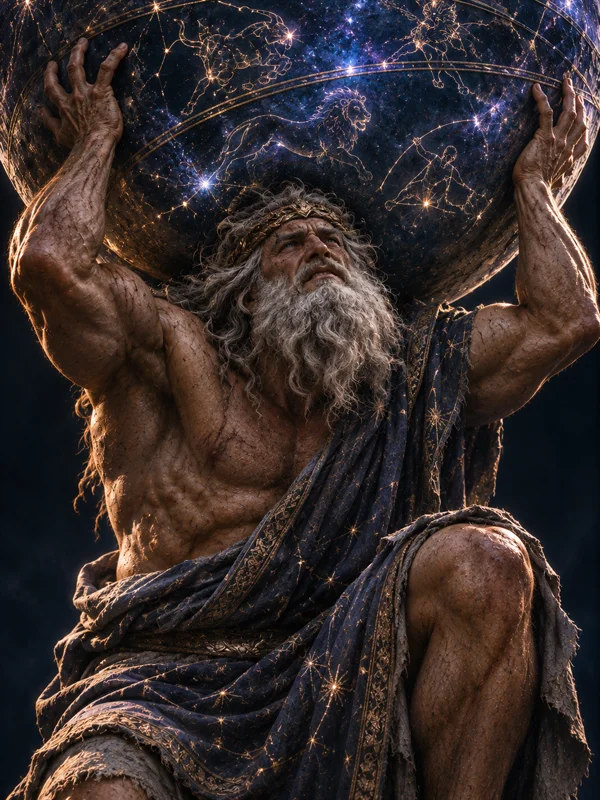
Atlas
The Titan who holds up the sky
“He holds up the wide sky, under hard necessity”
AT A GLANCE
- ROMAN
- Atlas
- DOMAIN
- Endurance; keeping earth and sky apart
- PARENTS
- Iapetus and Clymene (Asia in Apollodorus)
- SYMBOLS
- Celestial sphere, pillars of heaven
- HOME
- The western edge of the world
KEY MYTH
Atlas stands at the western edge of the world and holds up the sky on his head and hands (later writers say this was his punishment for leading the Titans; Homer says he holds the pillars that keep earth and sky apart). Heracles once took the weight while Atlas fetched him the golden apples, then tricked him into taking it back.
TITLES AND EPITHETS
Atlas
His name probably comes from a Greek root meaning “to bear” or “to endure”
Holder of the pillars
Homer's Atlas knows the depths of every sea and keeps the tall pillars that hold earth and sky apart
Father of the Pleiades
The seven sisters of the star cluster were called the Atlantides, “daughters of Atlas”
STORY
A Titan's son
Atlas was the son of the Titan Iapetus and the ocean nymph Clymene, and brother of Prometheus, Epimetheus and Menoetius. Hesiod calls him strong-hearted. Three of the four were punished by Zeus, and Epimetheus brought trouble on humankind by accepting Pandora.
The sentence
Hesiod simply says that Zeus gave Atlas his lot: to stand at the western edge of the world, near the Hesperides, and hold up the sky on his head and tireless hands. Hesiod gives no reason. In later accounts, such as Hyginus's, it was his punishment for leading the Titans in their lost war against the Olympians.
Daughters among the stars
With the ocean nymph Pleione he fathered the Pleiades, among them Maia, the mother of Hermes. He was also father of the Hyades, of the nymph Calypso, who kept Odysseus on her island for seven years, and in some versions of the Hesperides.
Heracles and the golden apples
In Apollodorus, Prometheus advised Heracles to send Atlas for the golden apples instead of fetching them himself. Heracles held the sky while Atlas went. Atlas came back with three apples and offered to deliver them himself. Heracles agreed, but asked him to hold the sky for a moment while he put a pad on his head. Atlas took it back, and Heracles walked off with the apples.
Perseus and the stone
In Ovid, Atlas is a giant king in the far west who guards a tree with golden fruit. Warned that a son of Zeus would rob him, he drove Perseus away. Perseus held up Medusa's head, and Atlas became a mountain range: his beard and hair turned to forest, his bones to rock, and the sky with all its stars rested on him.
Two stories, one Titan
The two myths cannot both be true in one timeline. If Perseus turned Atlas to stone, Atlas could not later meet Heracles, Perseus's great-grandson. Ancient writers simply told different versions.
POWERS
Endless strength
Strong enough to carry the whole weight of the heavens.
Endurance
He bears his burden without rest, for ever.
Knowledge of sea and sky
Homer says he knows the depths of every sea, and later writers made him the first astronomer, who taught people about the stars.
LEGACY TODAY
Atlases
Mercator chose the name 'Atlas' for his collection of maps, published in 1595 just after his death. He meant a legendary astronomer-king of Mauretania, but the name has stuck to every book of maps since.
The Atlantic and the Atlas Mountains
The 'Sea of Atlas' and the mountain range in North Africa both carry his name.
The Farnese Atlas
A Roman marble statue in Naples shows him kneeling under a celestial globe, often called the oldest surviving picture of the Greek constellations.
DID YOU KNOW
He holds the sky, not the Earth. The picture of Atlas carrying the planet is a much later mix-up.
The top bone of your neck, the one that holds up your skull, is called the atlas.
Plato's Atlantis had its own Atlas: its first king, a son of Poseidon, a different figure from the Titan.
FAMILY
- Parents
- Iapetus, Clymene
- Siblings
- Prometheus, Epimetheus, Menoetius
- Consorts and lovers
- Pleione
- Children
- The Pleiades, among them Maia, The Hyades, Calypso, The Hesperides (in some versions)