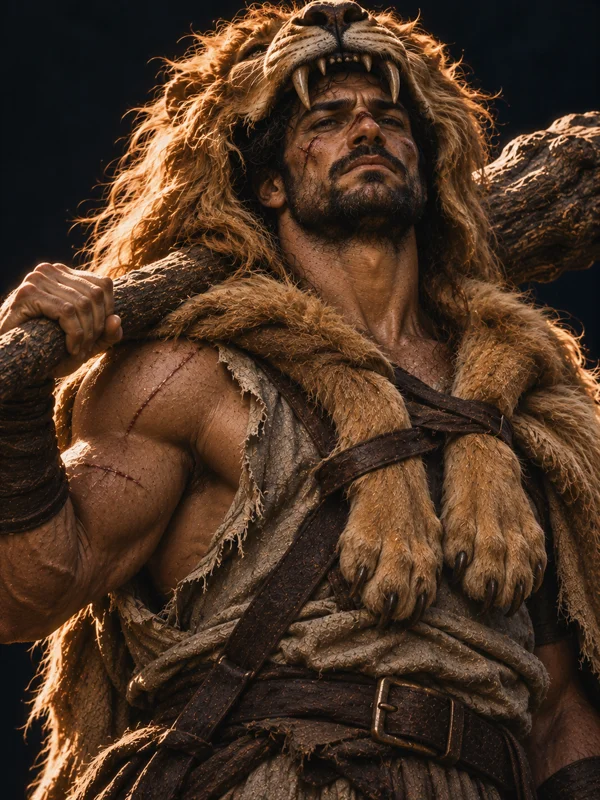
The Nemean Lion
1. The madness
Hera hated Heracles from birth, because he was Zeus' son by a mortal woman. When he was grown and married to Megara, she sent a madness on him, and he threw his own children into a fire. Euripides tells it the other way round, with the madness coming after the labours.
2. The oracle
Heracles went to Delphi to ask how he could be cleansed. The priestess told him to serve his cousin Eurystheus, king of Tiryns and Mycenae, for twelve years and to do the labours he set. At the end, she said, he would become immortal. Apollodorus says the original count was ten.
3. A lion no weapon could wound
The first task was to bring the skin of the lion of Nemea, a beast that no weapon could wound. Apollodorus says it was a child of the monster Typhon. On the way Heracles stayed with a poor labourer, Molorchus, who wanted to sacrifice for him. Wait thirty days, Heracles said: if I don't come back, sacrifice to me as a dead hero.
4. Arrows that bounced off
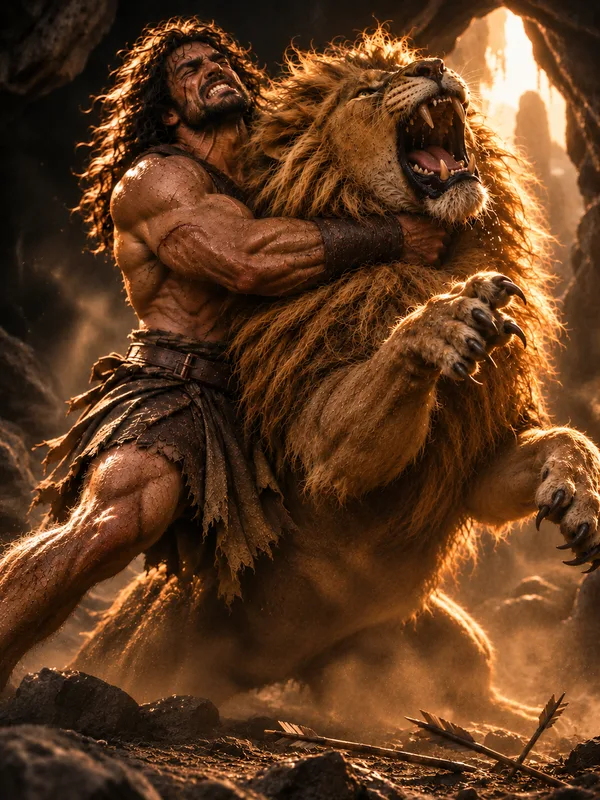
Heracles found the lion and shot at it, but the arrows bounced off its hide. He chased it with his club into its den, a cave with two entrances. He walled up one of them, went in through the other, threw his arms around the lion's neck and squeezed until it choked.
5. The lion skin
He carried the lion back on his shoulders. Molorchus was about to sacrifice to him as a dead man on the thirtieth day; instead they sacrificed together to Zeus. From then on Heracles wore the lion's skin, with its head as a helmet. Later poets say only the lion's own claws could cut the hide.
6. The king in the jar
When Eurystheus saw what Heracles had carried home, he was so frightened that he forbade him to enter the city again. From now on Heracles had to show his trophies outside the gates. Eurystheus also had a bronze jar made and buried in the ground, Apollodorus says, to hide in.
The Lernaean Hydra
7. The swamp of Lerna
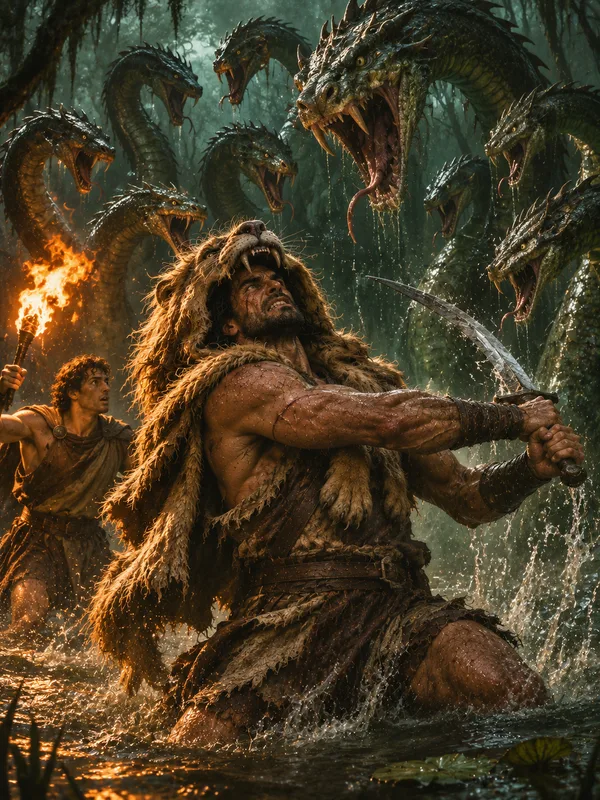
The second task was to kill the Hydra, which lived in the swamp of Lerna and came out to kill cattle and ravage the land. It was a child of Typhon and Echidna, a huge water serpent with nine heads. Eight of them were mortal, but the one in the middle was immortal.
8. Fire arrows
Heracles drove there in a chariot with his nephew Iolaus. He found the Hydra in its den by the spring of Amymone and shot burning arrows at it to force it out. When it came, he grabbed it, and it wrapped itself around one of his legs.
9. Two for every one
Heracles smashed its heads with his club, but every time one was crushed, two grew in its place. Then a giant crab came out of the swamp to help the Hydra and bit his foot. Heracles killed the crab. Later writers say Hera set it in the sky as the constellation Cancer.
10. Iolaus' torches
Heracles called for help. Iolaus set fire to part of the nearby wood, and each time Heracles cut off a head, Iolaus burned the stump with a flaming branch, so no new heads could grow. Head by head, the mortal ones were gone.
11. The head under the rock
Last came the immortal head. Heracles cut it off, buried it in the ground beside the road from Lerna to Elaeus, and put a heavy rock on top. Then he cut open the Hydra's body and dipped his arrows in its poisonous gall. From then on a scratch from his arrows could not be healed.
12. It doesn't count
Eurystheus refused to count this labour: Heracles had not done it alone, he said, because Iolaus had helped. That is why, in Apollodorus' telling, ten labours turned into twelve. The poisoned arrows would matter again and again, right up to Heracles' own death.
The Ceryneian Hind
13. The golden horns
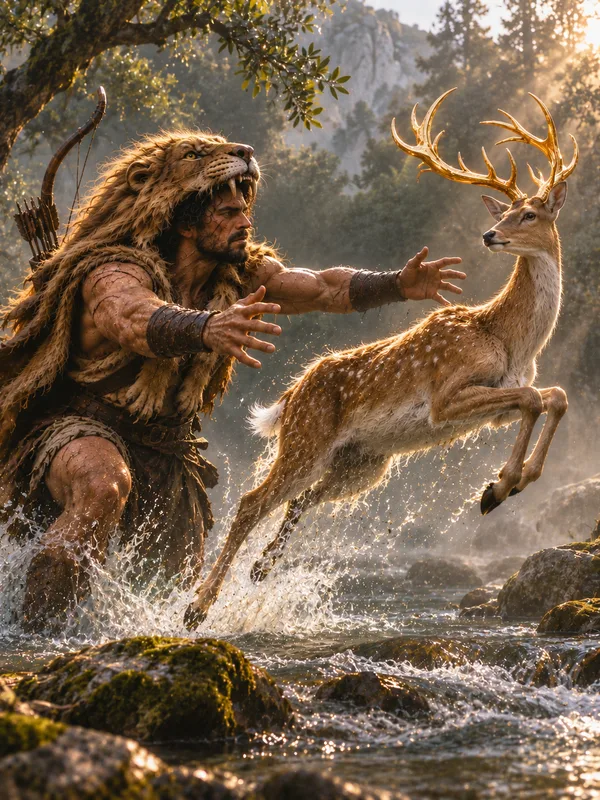
The third task was to bring back alive the hind of Ceryneia, a deer with golden horns that was sacred to the goddess Artemis. Heracles did not want to kill or wound it, so he could not simply shoot it.
14. A year of running
So he chased it, for a whole year. The hind ran without tiring, and Heracles followed it across the land. Later writers had it run as far as the land of the Hyperboreans in the far north, but Apollodorus keeps the chase in Greece.
15. The river Ladon
At last the hind grew tired and fled to Mount Artemisius and then to the river Ladon. As it was about to cross the stream, Heracles shot it, Apollodorus says, so carefully that it was only stopped, not killed. He caught it and lifted it onto his shoulders.
16. Caught by the twins
On the way back he met Artemis and her brother Apollo. The goddess was angry and was about to take her animal away from him, scolding him for trying to kill a creature sacred to her.
17. Not my choice
Heracles answered that he had no choice: it was Eurystheus' order. Artemis let her anger go and allowed him to carry the hind to Mycenae, alive and unharmed.
18. Speed instead of strength
This labour was different from the others. There was no monster to kill, and Heracles' strength was no help. He needed patience, endurance and respect for a goddess's animal.
The Erymanthian Boar
19. The mountain boar
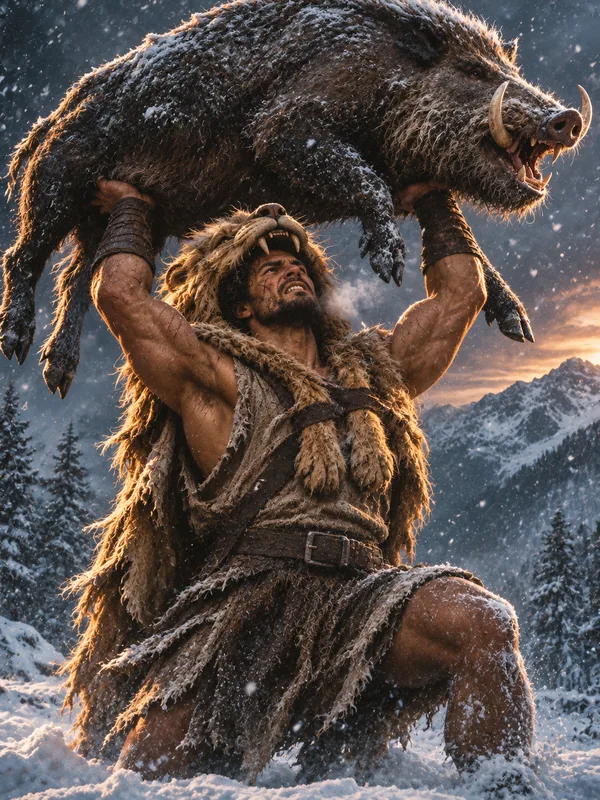
The fourth task was to bring back alive a huge boar that came down from Mount Erymanthus and ravaged the fields of Psophis in Arcadia.
20. The centaurs' wine
On the way Heracles was the guest of the centaur Pholus, who served him roast meat. Heracles asked for wine, and Pholus was afraid to open the jar that belonged to all the centaurs. Heracles opened it anyway. Diodorus says Dionysus himself had left the wine there.
21. The fight
The smell of the wine drew the other centaurs. They came armed with rocks and pine trees. Heracles drove them back with burning brands and arrows and chased them all the way to Malea, where the wise centaur Chiron lived.
22. Chiron's wound
One of Heracles' arrows went through a centaur's arm and stuck in Chiron's knee. It was poisoned with the Hydra's gall, and the wound would not heal. Chiron was immortal and could not die, so he lived in pain. Apollodorus says Prometheus offered to become immortal in Chiron's place, and Chiron was allowed to die.
23. Into the snow
Pholus died too: while he was looking at one of the arrows and wondering how something so small could kill, it slipped and fell on his foot. Heracles buried him and went on to the boar. He chased it out of a thicket with shouting into deep snow, where it tired, and he trapped it in a noose.
24. The king in the jar, again
Heracles carried the boar on his shoulders to Mycenae. Greek vase painters loved this scene: Heracles holding the boar up over his head, and Eurystheus hiding in his bronze jar with only his head and arms sticking out.
The Augean Stables
25. A humiliating task
The fifth task was meant to humiliate him: in a single day, alone, Heracles had to carry out all the dung of the cattle of Augeas, king of Elis. Augeas owned more herds than anyone, and the yards had never been cleaned.
26. The bargain
Heracles did not tell Augeas that the task was an order from Eurystheus. Instead he offered to clean everything in one day for a tenth of the cattle. Augeas did not believe it could be done and agreed. His son Phyleus was the witness.
27. Two rivers
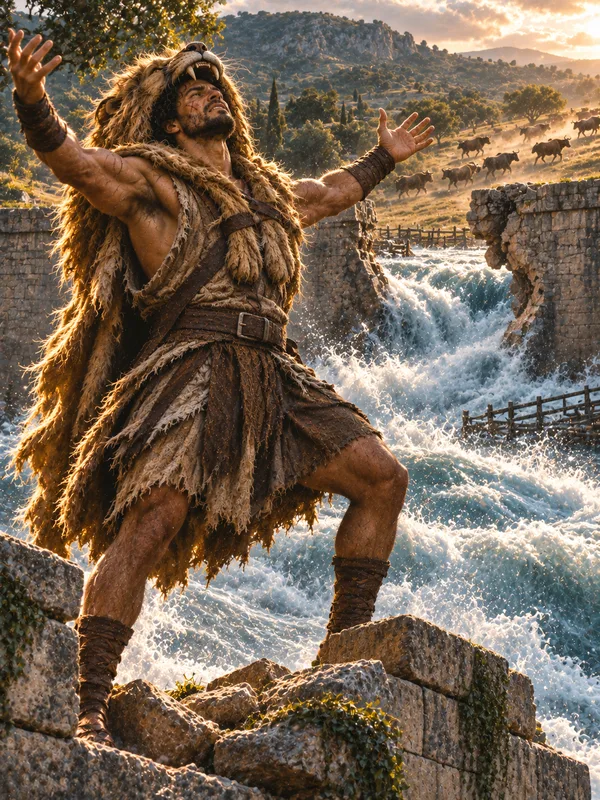
Heracles did not pick up a shovel. He broke a hole in the foundations of the cattle yard and dug channels from the two nearby rivers, the Alpheus and the Peneus. He let the water in at one side and out through an opening at the other.
28. Washed clean
The rivers rushed through the yards and carried away years of filth in a single day. The task that was meant to shame him became the most famous trick of all his labours. Even today, cleaning the Augean stables means tackling a huge mess that has built up for years.
29. No pay
When Augeas found out the job was Eurystheus' order, he refused to pay and denied he had ever promised. At the trial Phyleus told the truth against his own father, and Augeas angrily banished both his son and Heracles from Elis.
30. And Eurystheus said no
Eurystheus refused to count this labour too, because Heracles had done it for pay. Years later, Heracles came back to Elis and punished Augeas. Pindar says that afterwards, at Olympia, he founded the Olympic Games in honour of his father Zeus.
The Stymphalian Birds
31. The lake in the forest
The sixth task was to drive away the birds of Stymphalus. At a lake in Arcadia, surrounded by thick forest, a huge flock had gathered. Apollodorus says they had fled there out of fear of wolves.
32. Birds of bronze
Later writers made the birds much more frightening. Apollonius of Rhodes says they shot their feathers like arrows, and Pausanias says they ate people. Apollodorus describes only a huge flock that Heracles could not reach in the dense woods.
33. Athena's gift
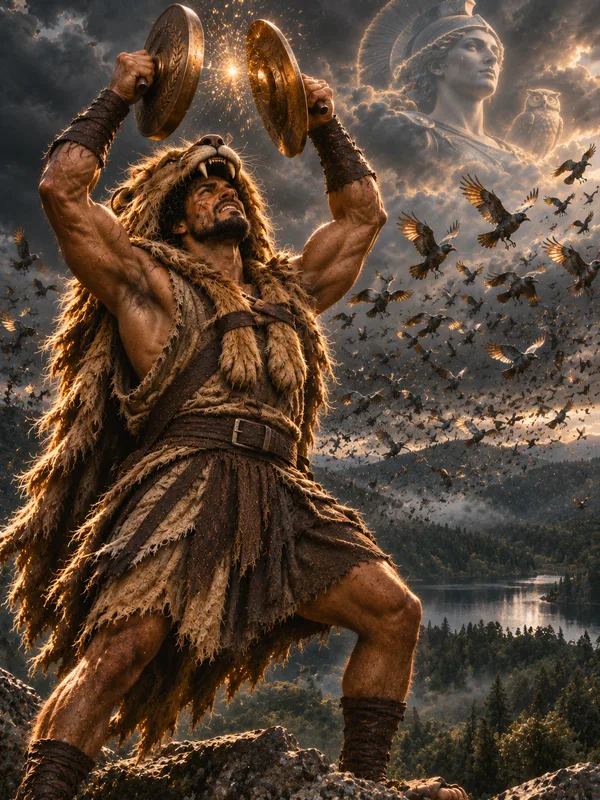
Heracles did not know how to drive the birds out of the forest. Athena helped him: she gave him a pair of bronze clappers that Hephaestus had made.
34. The noise
Heracles climbed a mountain beside the lake and clashed the clappers. The noise rang across the water and through the woods, and the terrified birds rose into the air all at once.
35. The arrows fly
As the flock took flight, Heracles shot them down with his arrows. Those that escaped never came back. In some later versions they flew off to an island in the Black Sea, where the Argonauts met them.
36. Half the labours done
Six labours were done, all of them in the Peloponnese, close to home. The next six would take Heracles far away: to Crete, to Thrace, to the land of the Amazons, to the edge of the world and finally below it.
The Cretan Bull
37. Poseidon's bull
The seventh task took Heracles to Crete, to bring back a bull. Acusilaus says it was the bull that had carried Europa across the sea for Zeus. Most say it was the bull Poseidon sent up from the sea when King Minos promised to sacrifice whatever came out of the waves.
38. A broken promise
The bull was so beautiful that Minos kept it for his herds and sacrificed another one. In anger Poseidon made the bull wild. In the same story he made Minos' wife Pasiphaë fall in love with it, and she gave birth to the Minotaur.
39. Catch it yourself
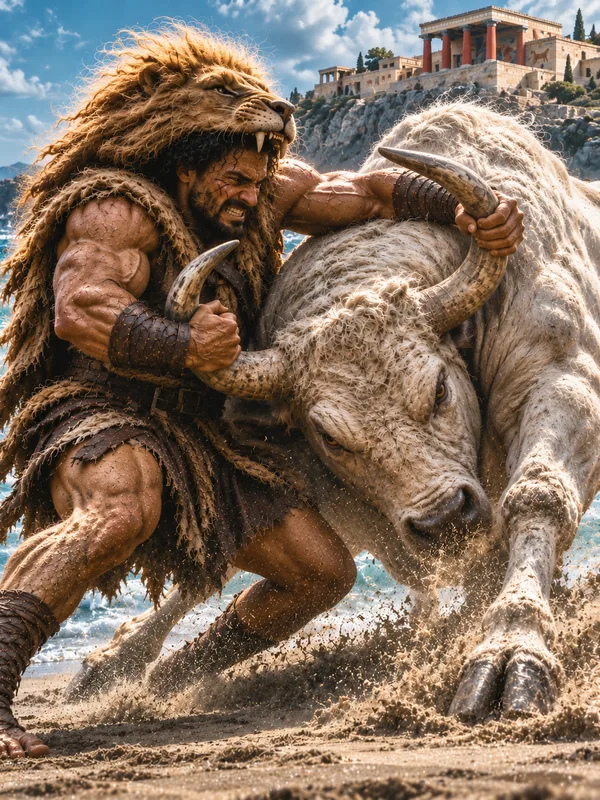
Heracles asked Minos for help. Minos told him to catch the bull himself if he could. Heracles wrestled it down with his bare hands.
40. Across the sea
He brought the bull to Mycenae. Diodorus says Heracles rode it across the sea to Greece, the way Europa had once crossed on a bull.
41. Set free
Eurystheus showed the bull and then let it go. The bull wandered through Sparta and Arcadia, crossed the Isthmus and came to Marathon near Athens, where it plagued the people.
42. The bull of Marathon
There, years later, the young hero Theseus caught it and sacrificed it. So the father of the Minotaur fell to the hero who would one day kill the Minotaur in the Labyrinth.
The Mares of Diomedes
43. Horses that ate people
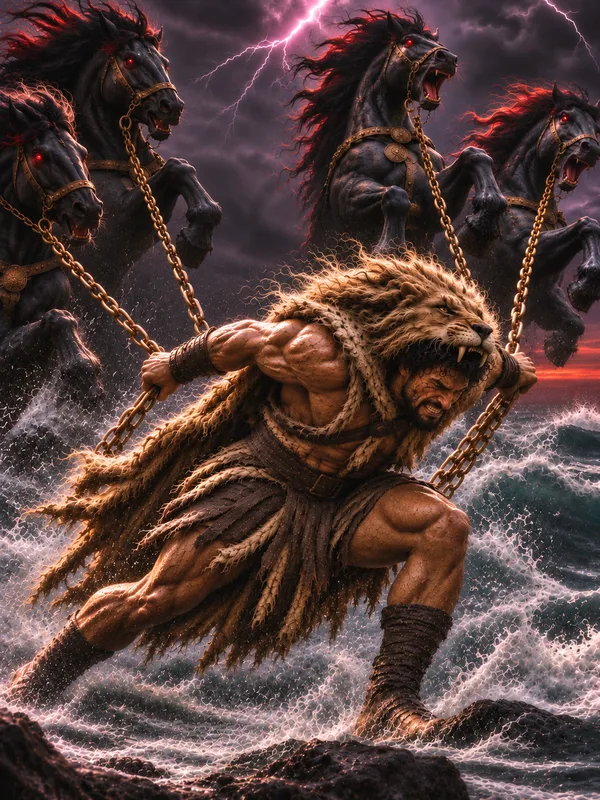
The eighth task was to bring the mares of Diomedes to Mycenae. Diomedes, a son of Ares, was king of the Bistones in Thrace, and he fed his mares on human flesh.
44. Wrestling Death
In Euripides' play Alcestis, Heracles stopped on the way at the house of his friend King Admetus, whose wife Alcestis had just died in his place. Heracles waited at her tomb, wrestled Death himself and brought her back to life. Apollodorus tells this story separately.
45. Down to the sea
Heracles sailed to Thrace with a band of volunteers. They overpowered the grooms in the stables and drove the mares down to the sea. The Bistones came running with weapons to take them back.
46. Abderus
Heracles left the mares in the care of his young friend Abderus, a son of Hermes, and turned to fight. While he was gone, the mares dragged Abderus to his death.
47. The king's end
Heracles defeated the Bistones and killed Diomedes. Diodorus adds that he threw the king to his own mares, and once they had eaten their master they became tame. Beside Abderus' grave Heracles founded a city and named it Abdera.
48. Back to the wild
Heracles brought the mares to Eurystheus, who set them free. Apollodorus says they wandered to Mount Olympus and were killed there by wild beasts.
The Belt of Hippolyta
49. A princess's wish
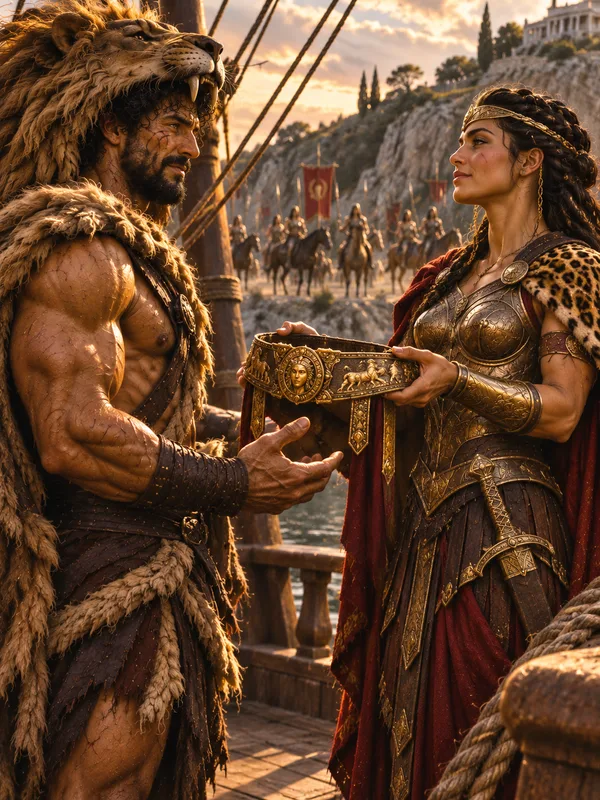
The ninth task was a gift for Eurystheus' daughter Admete. She wanted the belt of Hippolyta, queen of the Amazons. Ares had given it to her as a sign that she was the first among them.
50. The warrior women
The Amazons lived by the river Thermodon, on the Black Sea coast. They were a nation of women who were great at war. Heracles sailed there with a ship of volunteers and came into the harbour of Themiscyra.
51. A peaceful meeting
Hippolyta came to meet him at the ship. She asked why he had come, and when he told her, she promised to give him the belt.
52. Hera's rumour
But Hera disguised herself as an Amazon and went among the women, spreading the word that the strangers were carrying off their queen. The Amazons armed themselves and rode on horseback down to the ship.
53. The tragedy
When Heracles saw them coming armed, he thought it was a trap. He killed Hippolyta, took the belt, fought off the rest and sailed away. A promise of peace ended in a needless death because of one lie.
54. Troy on the way home
Sailing back, Heracles stopped at Troy. King Laomedon's daughter Hesione had been tied to a rock as food for a sea monster sent by Poseidon. Heracles killed the monster, but Laomedon cheated him of his reward, and years later Heracles came back and took the city.
The Cattle of Geryon
55. The red island
The tenth task was to bring the red cattle of Geryon from Erytheia, an island near the Ocean at the western edge of the world. Geryon had three bodies joined at the waist. His herdsman Eurytion and the two-headed dog Orthrus guarded the herd.
56. The Pillars of Heracles
Heracles crossed Europe and Libya, killing many wild beasts on the way. Where the two lands meet at the strait, he set up two pillars as a memorial of his journey. The Strait of Gibraltar has been called the Pillars of Heracles ever since.
57. The sun's cup
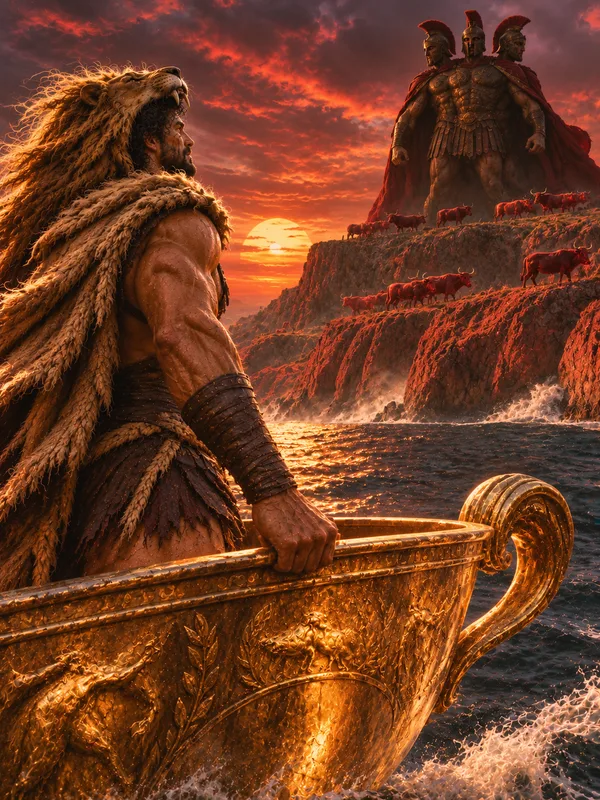
The sun was burning him on the way, so Heracles drew his bow at the Sun god Helios himself. Helios admired his nerve and lent him his golden cup, the bowl in which the sun sails back around the Ocean each night. In it Heracles crossed to Erytheia.
58. Three bodies
The dog Orthrus rushed at him, and Heracles killed it with his club, then Eurytion too. Menoetes, who herded the cattle of Hades nearby, ran to warn Geryon. Geryon caught up with Heracles by the river Anthemus and was shot dead.
59. The long drive home
Driving the cattle back overland was its own adventure. In Liguria two sons of Poseidon tried to steal them. In Italy a bull broke away and swam to Sicily, and Apollodorus says the land was named Italia after it, because the local word for bull was italos.
60. Hera's gadfly
Near the end, in Thrace, Hera sent a gadfly that stung the cattle and scattered them into the mountains. Heracles gathered back as many as he could and brought them to Eurystheus, who sacrificed them to Hera.
The Apples of the Hesperides
61. Two more
Ten labours had taken eight years and a month. But Eurystheus did not count the Hydra or the stables, so he set two more. The first was to bring golden apples from the garden of the Hesperides. Gaia had given them to Zeus and Hera at their wedding, and the serpent Ladon guarded them.
62. Where is the garden?
Nobody knew the way. Heracles caught the old sea god Nereus asleep and held on while Nereus changed into one shape after another, until he gave in and told him where the garden was.
63. Antaeus
In Libya the giant Antaeus, a son of Poseidon and Gaia, forced every traveller to wrestle him and killed them. Each time he was thrown, he touched his mother Earth and grew stronger. Heracles lifted him off the ground and crushed him in the air.
64. Prometheus set free
On the Caucasus mountains Heracles found Prometheus chained to a rock, where an eagle ate his liver every day. Heracles shot the eagle and freed him. In thanks, Prometheus advised him not to go into the garden himself, but to send Atlas.
65. Holding up the sky
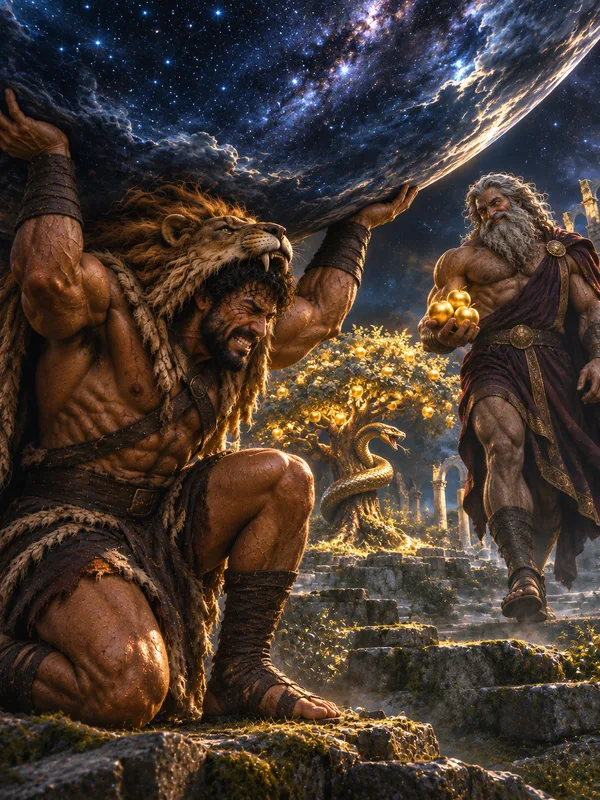
Atlas stood near the garden, holding the sky on his shoulders. Heracles offered to hold it for him while he fetched the apples. Atlas brought back three, but he liked his freedom: he said he would take them to Eurystheus himself, and Heracles could keep holding the sky.
66. The oldest trick
On Prometheus' advice, Heracles agreed, and asked Atlas to hold the sky for just a moment while he put a pad on his head. Atlas set the apples down and took the sky back. Heracles picked up the apples and left. Eurystheus later gave them back, and Athena returned them to the garden, where they belonged.
Cerberus
67. The last labour
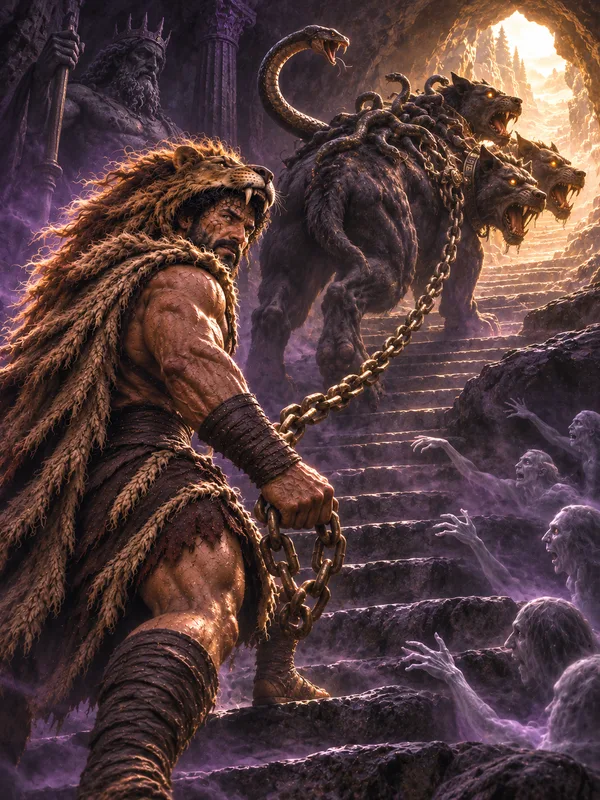
The twelfth and hardest task was to bring Cerberus up from the underworld, the dog that guarded the gates of Hades. Apollodorus describes him with three dog heads, a dragon's tail and snakes' heads all along his back. Before going, Heracles was initiated into the Mysteries at Eleusis.
68. Into the dark
Heracles went down through a cave at Taenarum, at the southern tip of the Peloponnese. In the Odyssey, Hermes and Athena guided him. When the souls of the dead saw him, they fled, all except Meleager and the Gorgon Medusa.
69. Only a shadow
Heracles drew his sword against Medusa, but Hermes told him she was only an empty shadow and could not harm him. In the land of the dead, even the Gorgon was just a ghost.
70. The chair of forgetting
Near the gates he found Theseus and his friend Pirithous, stuck to a seat of forgetfulness as punishment for trying to carry off Persephone. Heracles grabbed Theseus by the hand and pulled him free. When he tried to lift Pirithous, the earth shook, and he had to let him go.
71. No weapons
Heracles asked Hades for Cerberus. Hades agreed, on one condition: he had to master the dog without the weapons he carried. Heracles found Cerberus at the gates, protected only by his breastplate and the lion skin, threw his arms around the dog's heads and held on, even when the dragon tail bit him, until Cerberus gave in.
72. Free
He carried Cerberus up near Troezen and showed him to Eurystheus, who, the vase painters say, dived back into his jar. Then Heracles returned the dog to Hades. The twelve labours were done and Heracles was free. In the end, as the oracle had promised, he rose from his funeral pyre to Olympus as a god.
FIGURES IN THIS MYTH
SOURCES
Apollodorus' Library 2.4.12-2.5.12 (1st-2nd century CE), the only ancient text that tells all twelve in order. Details from Diodorus (Book 4), Euripides, Pindar, Homer's Odyssey, Apollonius and Pausanias are marked in the steps.