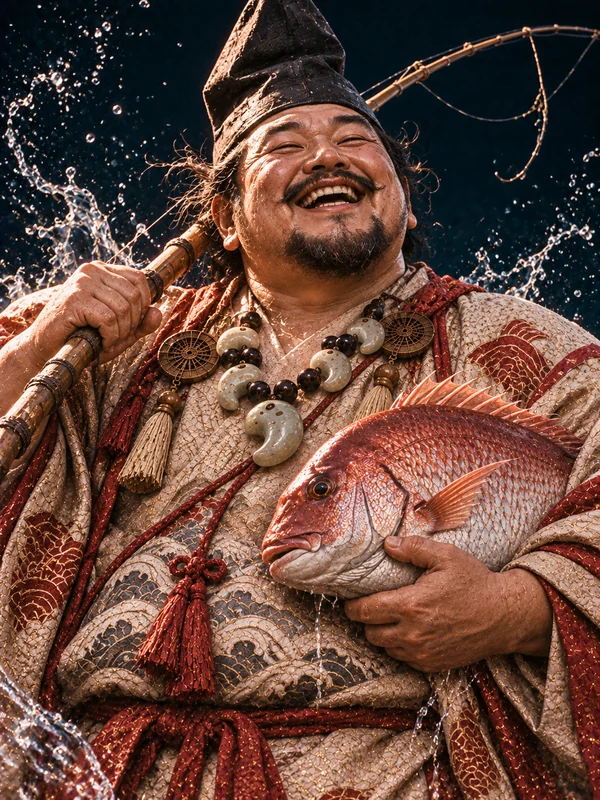
Ebisu
God of fishermen and good fortune
“The god who came back from the sea, laughing”
AT A GLANCE
- JAPANESE
- 恵比寿 (Ebisu)
- DOMAIN
- Fishing, business, good luck
- PARENTS
- Izanagi and Izanami (as Hiruko)
- SYMBOLS
- Fishing rod, red sea bream, tall hat
- HOME
- The seashore
KEY MYTH
Medieval belief made Ebisu the leech child Hiruko, whom Izanagi and Izanami set adrift in a reed boat, washed ashore and grown into a laughing god of the sea. Other shrines say he is Ōkuninushi's son Kotoshironushi. He became the patron of fishermen and merchants and the only native member of the Seven Lucky Gods.
TITLES AND EPITHETS
Ebisu-sama
The everyday, friendly way to call him
Nishinomiya Ōkami
“Great god of Nishinomiya”, the title at his head shrine
STORY
The leech child
The first child of Izanagi and Izanami, Hiruko, was born without bones because the ritual of their wedding was done wrong. His parents put him in a boat of reeds and let the sea carry him away.
Washed ashore
Medieval belief told how the boneless child drifted ashore at Nishinomiya, was cared for by the people there and grew into Ebisu, a cheerful god of the sea. To this day Hiruko is the god of the great Ebisu shrine at Nishinomiya.
The fisherman prince
Other shrines say Ebisu is Kotoshironushi, the son of Ōkuninushi, who was out fishing at Cape Miho when Amaterasu's envoys came to ask for the land.
One of the Seven Lucky Gods
By the Middle Ages Ebisu had become the patron of fishermen, then of merchants and good business. He is the only one of the Seven Lucky Gods who comes from Japan itself; the rest came from Buddhist, Hindu or Chinese tradition.
POWERS
Good catches
He brings fish to the nets and keeps fishermen safe.
Business luck
Merchants pray to him for customers and honest profit.
Cheer
He is always smiling, a god of easy, everyday happiness.
WORSHIP
Nishinomiya Shrine, Hyōgo
The head of some 3,500 Ebisu shrines. Every January 10 men race through its gates, and the winner is named the year's Lucky Man.
Imamiya Ebisu Shrine, Osaka
Its Tōka Ebisu festival in January draws about a million people who buy lucky bamboo branches for their shops.
LEGACY TODAY
Ebisu, Tokyo
The Tokyo district and its station are named after Yebisu beer, which was named after the god and brewed there from the 1890s.
The lucky ships
Ebisu rides with the other lucky gods on the treasure ship, Takarabune, whose picture people put under their pillows for a good first dream of the year.
DID YOU KNOW
Folk belief says Ebisu is deaf, so in the tenth month, when all the gods go to Izumo, he does not hear the call and stays home to guard the villages.
Washed-up whales, driftwood and other gifts from the sea were once also called “ebisu”.
He is usually shown with a fishing rod and a red sea bream, a fish eaten at celebrations.
FAMILY
- Parents
- Izanagi, Izanami