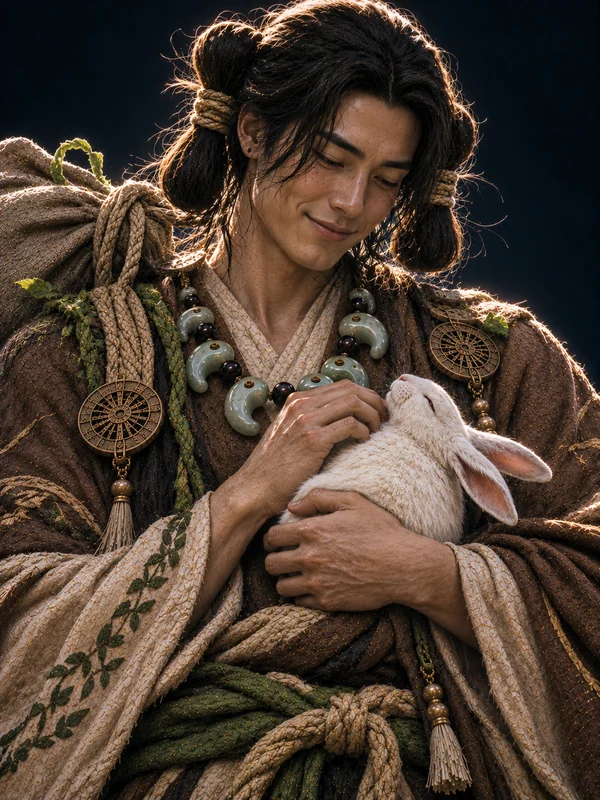
Ōkuninushi
Great lord of the land
“He built the land, then gave it away”
AT A GLANCE
- JAPANESE
- 大国主神 (Ōkuninushi-no-Kami)
- DOMAIN
- The land, healing, marriage and bonds
- PARENTS
- Susanoo (his son in the Nihon Shoki, a descendant in the Kojiki)
- SYMBOLS
- White hare, sack, Susanoo's sword and harp
- HOME
- Izumo
KEY MYTH
Ōkuninushi healed the white hare of Inaba, survived being killed twice by his jealous brothers, passed Susanoo's deadly trials and ran off with his daughter. He built the land with the tiny god Sukunabikona, then handed it over to Amaterasu's line in return for the great shrine of Izumo.
TITLES AND EPITHETS
Ōnamuji
His name as a young man in the Kojiki
Yachihoko
“Eight thousand spears”, his name as a warrior and suitor
STORY
The white hare of Inaba
Ōnamuji's eighty brothers set out to court Princess Yakami, making him carry their bags. On the way they met a hare skinned raw by the sea creatures it had tricked, and cruelly told it to bathe in salt water. Ōnamuji told it to wash in fresh water and roll in cattail pollen. Healed, the hare foretold that he, not his brothers, would win the princess.
Killed twice
The jealous brothers rolled a red-hot boulder down a mountain, telling him it was a boar to catch, and he burned to death. His mother begged the gods of heaven, who sent two shell goddesses to bring him back to life. The brothers killed him again in a split tree, and again he was revived.
The trials of Susanoo
He fled to Susanoo in the Land of Roots and fell in love with his daughter Suseri-hime. Susanoo made him sleep in a room of snakes and a room of centipedes and wasps, then set fire to a field around him, where a mouse showed him a hole to hide in. At last he tied the sleeping Susanoo's hair to the rafters and ran off with Suseri-hime and Susanoo's sword, bow and harp.
Building the land
Susanoo shouted after him to become Ōkuninushi, “Great Lord of the Land”. With the tiny god Sukunabikona, who arrived in a boat made of a seed pod, he shaped the country, taught medicine and showed people how to fight off pests.
Giving the land away
Amaterasu sent envoys to claim the land for her grandson. One son agreed; the other, Takeminakata, wrestled the thunder god Takemikazuchi, lost and fled to Suwa. Ōkuninushi yielded the visible world, asking only for a palace whose pillars reached the heavens. That palace is Izumo Taisha.
POWERS
Lord of the land
Ruler of the earthly realm before he handed it over.
Healing
The great healer of Japanese myth, from the hare to the medicines he taught.
Bonds
He rules en-musubi, the invisible ties between people, above all marriage.
WORSHIP
Izumo Taisha, Shimane
One of the oldest and most important shrines in Japan. Remains of giant pillars made of three bound tree trunks, found in 2000, show how tall its hall once was.
Hakuto Shrine, Tottori
A shrine by the coast of Inaba honours the white hare he healed, and couples pray there for love.
LEGACY TODAY
The month of the gods
Tradition says all the gods of Japan gather at Izumo in the tenth lunar month. Elsewhere it is called Kannazuki, “the month without gods”; in Izumo it is Kamiarizuki, “the month with gods”.
Daikoku
Because his name can be read Daikoku, he merged with Daikokuten, the smiling god of wealth with a sack and mallet, one of the Seven Lucky Gods.
DID YOU KNOW
Visitors at Izumo Taisha clap four times instead of the usual two.
The Kojiki gives him five names; in the Nihon Shoki he is called Susanoo's son, in the Kojiki his descendant six generations down.
To fool Susanoo while picking “lice” from his hair, he chewed berries and red clay so it looked as if he was biting centipedes.
FAMILY
- Parents
- Susanoo
- Consorts and lovers
- Suseri-hime, Susanoo's daughter, Yakami-hime of Inaba, Nunakawa-hime of Koshi
- Children
- Kotoshironushi, Takeminakata