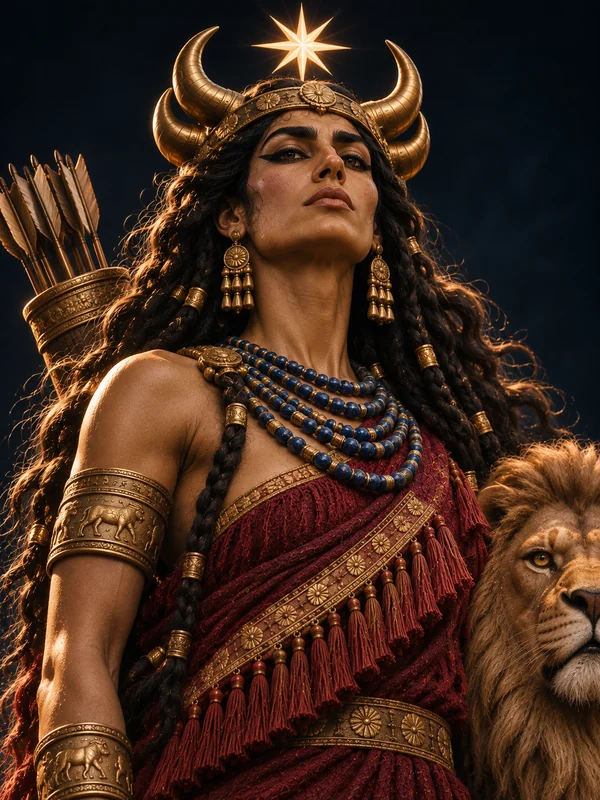
Inanna
Queen of heaven
“Open the gate, or I will raise the dead to eat the living”
AT A GLANCE
- ANCIENT NAME
- Inanna (Sumerian), Ishtar (Akkadian)
- DOMAIN
- Love, war, the planet Venus
- PARENTS
- Nanna and Ningal
- SYMBOLS
- Eight-pointed star, lion, rosette
- HOME
- Uruk
KEY MYTH
She went down to the underworld, gave up her powers at seven gates and died, and Enki brought her back. To leave she had to send someone in her place: her husband Dumuzi.
TITLES AND EPITHETS
Queen of Heaven
Her Sumerian name is usually read as nin-an-ak, “Lady of Heaven”
Ishtar
Her Akkadian name, under which she was worshipped in Babylon and Assyria
STORY
The seven gates
Inanna decided to go down to the underworld, the realm of her sister Ereshkigal. At each of its seven gates she had to give up one of her powers: her crown, her necklace, her robe. She came before her sister naked and powerless, and was struck dead and hung on a hook.
A life for a life
After three days her servant Ninshubur went for help, and Enki brought her back to life. But no one leaves the underworld without a substitute. Back home, Inanna found her husband, the shepherd Dumuzi, sitting on his throne instead of mourning her, and gave him to the demons. Later his sister Geshtinanna agreed to share his fate, half a year each.
The king who said no
In the Epic of Gilgamesh, Ishtar asks Gilgamesh to marry her. He refuses and lists what happened to her earlier lovers: one became a bird with a broken wing, one a wolf hunted by his own dogs. Furious, she gets the Bull of Heaven from Anu to destroy him.
POWERS
Love and desire
She was the goddess of love, sex and attraction, in all their joy and danger.
War
Battle was called “the playground of Inanna”, and kings marched with her blessing.
The morning and evening star
She was the planet Venus, the brightest light in the sky after the sun and moon.
WORSHIP
Uruk
Her temple, the Eanna (“House of Heaven”) in Uruk, was one of the largest temple complexes of early Sumer. The writing system itself first appears in tablets from it, around 3300 BCE.
The first author
Around 2300 BCE, Enheduanna, the daughter of King Sargon of Akkad and high priestess at Ur, wrote hymns to Inanna. She is the first author in history known by name.
LEGACY TODAY
The Ishtar Gate
Nebuchadnezzar II built a gate to Babylon in her name around 575 BCE, covered in blue glazed bricks with lions, bulls and dragons. It now stands rebuilt in the Pergamon Museum in Berlin.
Goddesses of love
The Phoenician Astarte is closely related to Ishtar, and many scholars think the Greek Aphrodite owes something to them both.
DID YOU KNOW
Her symbol is an eight-pointed star and her sacred animal is the lion.
Goddesses in Sumerian poems speak a special dialect, Emesal, and many of Inanna's lines are written in it.
In some texts, especially from Uruk, she is the daughter of An, not of the moon god Nanna.
FAMILY
- Parents
- Nanna, Ningal, the moon's wife
- Siblings
- Shamash, Ereshkigal
- Consorts and lovers
- Dumuzi
ECHOES IN OTHER WORLDS
Aphrodite (Greek)
Many scholars think Aphrodite grew partly out of Ishtar, through the Phoenician goddess Astarte and Cyprus. Both are goddesses of love and desire, and both were linked with the planet Venus.