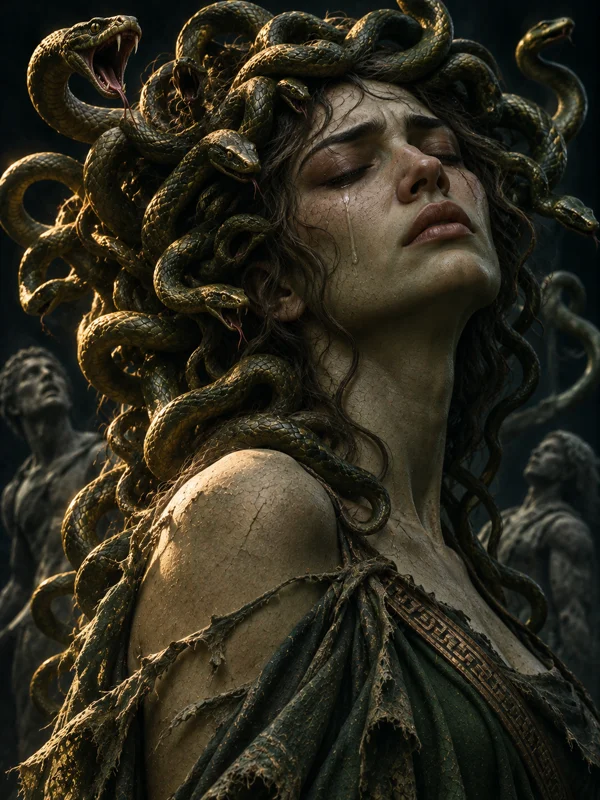
Medusa
The Gorgon
“The only mortal Gorgon”
AT A GLANCE
- ROMAN
- —
- DOMAIN
- Her gaze turns people to stone
- PARENTS
- Phorcys and Ceto
- SYMBOLS
- Snake hair, the Gorgon face
- HOME
- An island at the edge of the world
KEY MYTH
In Ovid's version she was a beautiful priestess; Poseidon assaulted her in Athena's temple, and Athena punished Medusa with snakes for hair. Perseus later beheaded her.
TITLES AND EPITHETS
Gorgo
“The terrible one”
Medousa
Her name means “guardian” or “ruler”
STORY
Three sisters
Medusa and her sisters Stheno and Euryale were the Gorgons, daughters of ancient sea gods. Her sisters were immortal. Only Medusa could die.
The curse
In Ovid's version she was a beautiful priestess of Athena. Poseidon assaulted her inside Athena's temple, and Athena punished Medusa, not him, turning her hair into snakes and her gaze into stone.
The garden of statues
She lived at the edge of the world. Around her lair stood the stone figures of everyone who had come to kill her.
Perseus
Perseus approached while she slept, guided by Athena and watching her only in his polished shield. He cut off her head with one stroke.
Her children
From her neck sprang her two sons by Poseidon: the winged horse Pegasus and the warrior Chrysaor, born with a golden sword.
After death
Perseus used her head as a weapon, then gave it to Athena, who set it on her aegis. Her blood was collected too: from one side it healed, from the other it killed.
POWERS
Petrifying gaze
Anyone who met her eyes turned to stone.
Living snakes
Her hair hissed and writhed.
Magic blood
Asclepius used it to heal, and even to raise the dead.
Power beyond death
Her severed head kept its deadly gaze.
LEGACY TODAY
The gorgoneion
Her face was painted on shields, armour, coins and temple roofs to scare away evil.
The flag of Sicily
Her head sits at the centre of the three-legged symbol on Sicily's flag.
Jellyfish
Biologists call the free-swimming jellyfish form a “medusa”, after her trailing hair.
DID YOU KNOW
In early Greek art she is a grinning monster with tusks and a lolling tongue. Only later did artists make her beautiful.
In Ovid, drops of her blood falling on the Libyan desert became its snakes.
Caravaggio painted her face on a real wooden shield, now in the Uffizi in Florence.
FAMILY
- Parents
- Phorcys, Ceto
- Siblings
- Stheno, Euryale, The Graeae
- Consorts and lovers
- Poseidon
- Children
- Pegasus, Chrysaor
ECHOES IN OTHER WORLDS
Humbaba (Mesopotamian)
Monstrous faces beheaded by heroes, then used to frighten evil away. Clay masks of Humbaba's face and the Gorgon's head on Greek shields and doorways have often been compared.