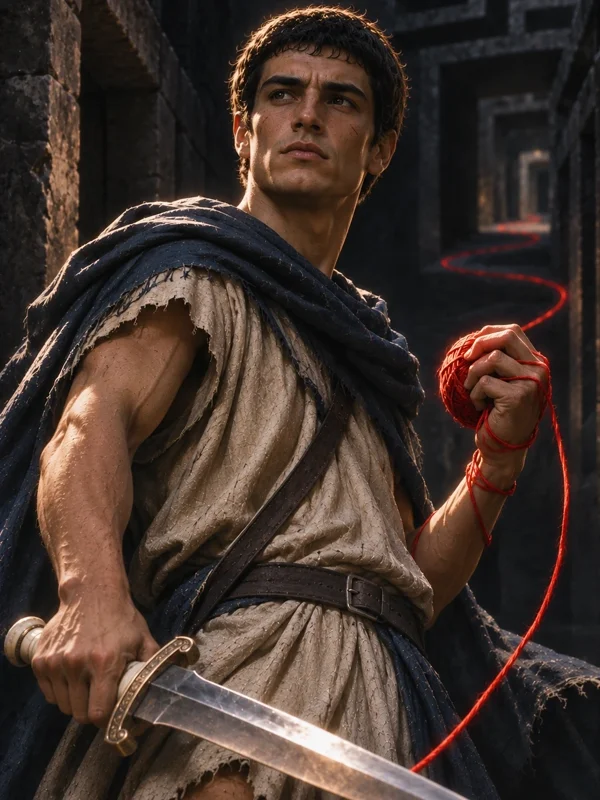
Theseus
Hero of Athens
““Not without Theseus”, as the Athenian saying went”
AT A GLANCE
- ROMAN
- Theseus
- DOMAIN
- Slayer of monsters; legendary king who united Attica
- PARENTS
- Aegeus (or Poseidon, in some versions) and Aethra
- SYMBOLS
- Sword, sandals, club, Ariadne's thread
- HOME
- Troezen and Athens
KEY MYTH
Athens had to send seven young men and seven young women to Crete as food for the Minotaur. In most versions Theseus volunteered to go with them. Princess Ariadne gave him a ball of thread: he tied it at the entrance of the Labyrinth, killed the Minotaur and followed the thread back out.
TITLES AND EPITHETS
Another Heracles
An old saying the Athenians used for him, because his deeds matched the great hero's
Uniter of Attica
Credited with uniting the villages of Attica into one city, the synoikismos
Son of Poseidon
A claim made in some versions, which he proved by diving to the bottom of the sea
Slayer of the Minotaur
The deed that made him the hero of Athens
STORY
The rock at Troezen
King Aegeus of Athens had no son. After a night with Aethra, princess of Troezen, he hid his sword and sandals under a huge rock and said: if a son is born and can lift it, send him to Athens. In some versions Poseidon also visited Aethra that night. Grown up, Theseus lifted the rock with ease.
The road of bandits
Instead of sailing safely, he walked the coast road to Athens and gave every bandit a taste of his own cruelty. He took the club of Periphetes, tore Sinis apart with the bent pine trees Sinis used on travellers, kicked Sciron off his own cliff and cut Procrustes to fit his own bed.
Medea's poison
In Athens, Aegeus had married the sorceress Medea. She recognised the newcomer and talked the king into handing him a cup of poison at a feast. When Theseus drew his sword to carve the meat, Aegeus knew it at once and knocked the cup away.
Beneath the sea
On the voyage to Crete, King Minos mocked his claim to be Poseidon's son and threw a gold ring into the sea. In Bacchylides' poem, Theseus dived after it, was carried by dolphins to the palace of the sea goddess Amphitrite, and came back up dry, wearing a purple robe and a wreath she had given him. Later writers such as Pausanias and Hyginus add that he brought the ring back too.
Into the Labyrinth
In most versions he volunteered as one of the fourteen young Athenians sent to feed the Minotaur. Minos's daughter Ariadne fell in love with him and gave him a ball of thread. He tied it at the entrance, killed the Minotaur deep in the maze and followed the thread back out.
Naxos and the black sails
On the way home he left Ariadne asleep on the island of Naxos, where, in most versions, the god Dionysus found her and made her his wife. Theseus had promised his father white sails if he came back alive, but forgot. Aegeus saw the black sails, believed his son was dead and threw himself to his death. In some versions he leapt into the sea, which was named the Aegean after him.
The chairs of forgetfulness
As king, Theseus joined his friend Pirithous in a reckless plan to carry off Persephone from the underworld. Hades welcomed them and offered them seats, which held them fast. When Heracles came down for Cerberus he pulled Theseus free, but the earth shook when he reached for Pirithous, who stayed behind for ever.
POWERS
Strength and skill
Strong enough as a young man to lift Aegeus's rock, and said to be the first to win at wrestling by technique instead of brute force.
The bandit's club
He kept the club of Periphetes, the first bandit he killed, and carried it as Heracles carried his lion skin.
Turning the tables
He beat each villain on the road with that villain's own method.
Three wishes
In Euripides, Poseidon granted him three wishes. He used one in anger to curse his own son Hippolytus, and regretted it.
WORSHIP
The Theseion
Athens honoured him as a hero at his shrine. Around 475 BC the general Cimon brought home bones from the island of Skyros, said to be his.
The Theseia
A yearly festival in his honour, held in the autumn month of Pyanepsion.
The Oschophoria
An Athenian festival with a procession that was said to recall his return from Crete.
LEGACY TODAY
The Ship of Theseus
The Athenians kept his ship for centuries, replacing rotten planks one by one. Philosophers still argue whether it stayed the same ship.
The temple above the agora
The well-preserved Temple of Hephaestus in Athens was long called the 'Theseion' by mistake, because its sculptures show his deeds.
Ariadne's thread
The phrase still means a clue that leads you out of a tangled problem.
DID YOU KNOW
A 'Procrustean bed' still means forcing everything to fit one rigid standard.
In Greek art he is almost always a beardless young man, unlike the bearded Heracles.
In some stories he and Pirithous also kidnapped the young Helen from Sparta, and her brothers Castor and Pollux took her back.
FAMILY
- Parents
- Aegeus, king of Athens, Aethra, princess of Troezen, Poseidon
- Consorts and lovers
- Ariadne, Antiope or Hippolyta, the Amazon queen, Phaedra
- Children
- Hippolytus, Demophon, Acamas