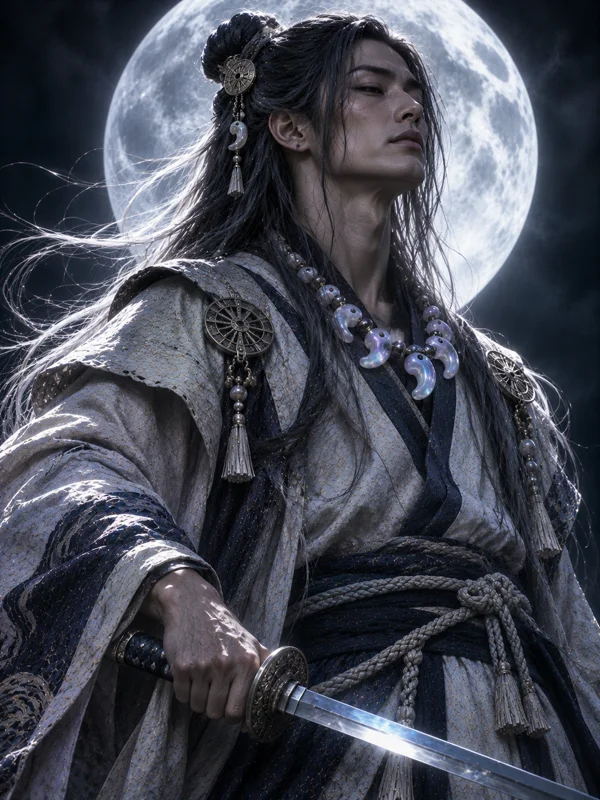
Tsukuyomi
God of the moon
“The god who counts the moons”
AT A GLANCE
- JAPANESE
- 月読命 (Tsukuyomi-no-Mikoto)
- DOMAIN
- The moon, night, the reckoning of time
- PARENTS
- Izanagi, born from his right eye
- SYMBOLS
- Full moon, night sky
- HOME
- The realm of night
KEY MYTH
In the Nihon Shoki, Amaterasu sent Tsukuyomi to visit the food goddess Ukemochi. She welcomed him by producing rice, fish and game from her mouth. Disgusted, he killed her. Amaterasu was so angry that she refused ever to see him again, and so the sun and the moon never meet: one rules the day, the other the night.
TITLES AND EPITHETS
Tsukuyomi-no-Mikoto
Usually read as “moon-reckoning”, from tsuki (moon) and yomi (counting)
Tsukiyumi-no-Mikoto
“Moon bow”, another form of his name in the Nihon Shoki
STORY
Born of the right eye
When Izanagi washed his right eye after returning from Yomi, Tsukuyomi was born, the second of the three noble children.
The realm of night
Izanagi gave him the realm of night to rule. In one variant of the Nihon Shoki he is told to rule the plains of the sea instead.
The feast of Ukemochi
Amaterasu sent him to visit the food goddess Ukemochi. She turned to the land and rice came from her mouth, to the sea and fish came out, to the hills and game came out, and she served it all to him.
The killing
Outraged at being served food from a mouth, Tsukuyomi drew his sword and killed her.
Day and night
Amaterasu was furious and said she would never meet him face to face again. Ever since, the sun and the moon dwell apart, one ruling the day and the other the night.
POWERS
The moon
He rules the moon and the night sky.
Time
His name links him to counting the months, the basis of the old lunar calendar.
Night
He governs the darkness between sunset and sunrise.
WORSHIP
Tsukiyomi-no-miya, Ise
Separate shrines to him stand beside both the Outer and the Inner Shrine at Ise.
Tsukiyomi Shrine, Kyoto
A small shrine belonging to Matsunoo Taisha in Kyoto honours him.
LEGACY TODAY
Naruto
The Tsukuyomi illusion in the manga and anime is named after him.
Moon viewing
Tsukimi, the autumn moon-viewing festival, carries on Japan's old love of the moon, though it is not a festival of his.
DID YOU KNOW
Unlike Greek and Roman myth, where the moon is a goddess and the sun a god, Japanese myth makes the moon a god and the sun a goddess.
In the Kojiki the same killing is told of Susanoo, who kills the food goddess Ōgetsu-hime.
From Ukemochi's body came the ox and the horse, millet, silkworms, rice, wheat and beans.
FAMILY
- Parents
- Izanagi
- Siblings
- Amaterasu, Susanoo
ECHOES IN OTHER WORLDS
Nanna (Mesopotamian), Thoth (Egyptian)
Moon gods and keepers of time. Nanna set the months, Thoth the moon god was the reckoner of time, and Tsukuyomi's name may mean “moon counting”.