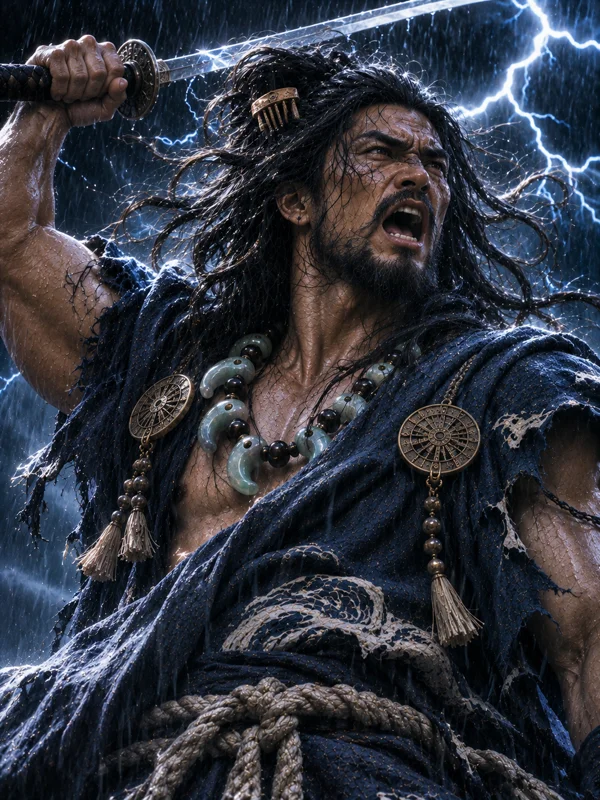
Susanoo
God of storms
“The storm who wept, raged and became a hero”
AT A GLANCE
- JAPANESE
- 須佐之男命 (Susanoo-no-Mikoto)
- DOMAIN
- Storms, the sea, later Izumo and the Land of Roots
- PARENTS
- Izanagi, born from his nose
- SYMBOLS
- Totsuka sword, Kusanagi sword
- HOME
- Izumo; later the Land of Roots (Ne-no-kuni)
KEY MYTH
Susanoo wept and raged so wildly that he was banished from heaven. In Izumo he met an old couple whose daughters had been eaten one by one by the eight-headed serpent Yamata no Orochi. He turned the last daughter, Kushinada, into a comb in his hair, set out eight vats of strong sake and cut the drunken serpent to pieces. In its tail he found the sword Kusanagi.
TITLES AND EPITHETS
Takehaya Susanoo-no-Mikoto
“Brave, swift, impetuous male”
Gozu Tennō
“Ox-headed heavenly king”, the plague-averting god he was merged with in medieval Japan
STORY
Born of the nose
When Izanagi washed his nose after Yomi, Susanoo was born. He was given the sea to rule, but instead he wept and howled for his dead mother until the green mountains withered and the rivers dried up.
Banished
Izanagi banished him. Before leaving he went up to heaven to say goodbye to his sister Amaterasu, shaking the mountains and rivers as he went.
Chaos in heaven
After the oath contest he claimed victory and ran wild, wrecking rice fields and throwing a flayed horse into the sacred weaving hall. Amaterasu hid in her cave and the world went dark. The gods fined him, cut his beard and nails, and threw him out of heaven.
The old couple of Izumo
Coming down by the river Hi in Izumo, he found an old couple weeping. The eight-headed serpent Yamata no Orochi had eaten seven of their eight daughters and was coming for the last, Kushinada.
Slaying the serpent
He turned Kushinada into a comb in his hair, had eight vats of strong sake brewed and set behind a fence with eight gates. The serpent drank from all eight and fell asleep, and Susanoo cut it to pieces until the river ran red. Inside its tail he found the sword Kusanagi, which he gave to Amaterasu.
The first poem
He married Kushinada and built a palace at Suga, where clouds rose around them. There he sang the first poem in Japanese: “Eight clouds rise, an eightfold fence of Izumo…”. In the end he went to rule the Land of Roots.
POWERS
Storms
Rain, wind and wild weather follow him.
The sea
In the Kojiki, Izanagi gives him the sea to rule.
Slayer of monsters
Brute force and a clever trick with sake killed Yamata no Orochi.
WORSHIP
Yasaka Shrine, Kyoto
His main shrine in Kyoto, home of the Gion Matsuri, one of Japan's greatest festivals.
Suga Shrine, Shimane
Said to stand where he built his palace with Kushinada. It calls itself the birthplace of Japanese poetry.
Hikawa shrines
Hundreds of Hikawa shrines around Saitama and Tokyo honour him, named after the river Hi.
LEGACY TODAY
Kusanagi
The sword from the serpent's tail is one of the three imperial treasures, said to be kept at Atsuta Shrine in Nagoya.
Iwami kagura
Folk sacred dances in Shimane still re-enact his fight with the giant serpent.
Games
He appears in games such as Ōkami and the Persona series.
DID YOU KNOW
His poem is traditionally called the first waka, the classic Japanese poem of 31 syllables.
In the Kojiki he, not Tsukuyomi, kills a food goddess, Ōgetsu-hime, and the first crops grow from her body.
Kusanagi means “grass-cutter”: the hero Yamato Takeru later used it to cut down burning grass and escape a trap.
FAMILY
- Parents
- Izanagi
- Siblings
- Amaterasu, Tsukuyomi
- Consorts and lovers
- Kushinada-hime
- Children
- Ōkuninushi
ECHOES IN OTHER WORLDS
Marduk (Mesopotamian), Zeus (Greek), Ra (Egyptian)
A god who defeats a giant serpent of chaos and saves the order of the world: Marduk kills Tiamat, Zeus defeats Typhon, Susanoo slays Orochi, and Ra fights Apophis every night.
Set (Egyptian)
Wild storm gods who fight their own family. Susanoo wrecks his sister Amaterasu's rice fields and hall; Set murders his brother Osiris and fights his nephew Horus.