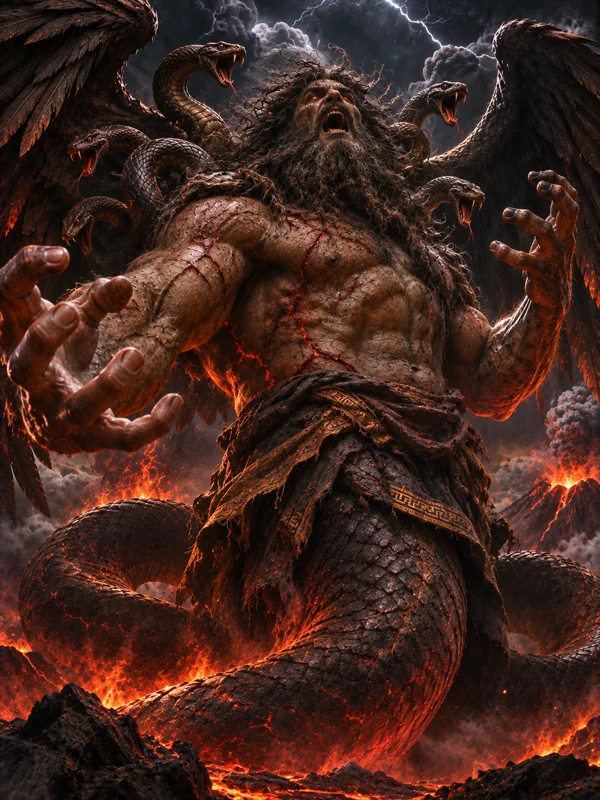
Typhon
Father of monsters
“The last and most terrible child of Gaia”
AT A GLANCE
- ROMAN
- —
- DOMAIN
- Storm winds, volcanic fire, chaos
- PARENTS
- Gaia and Tartarus
- SYMBOLS
- Serpent coils, wings, a hundred snake heads
- HOME
- Under Mount Etna (Pindar); in Tartarus (Hesiod)
KEY MYTH
Gaia's last and most terrible child rose to overthrow Zeus. In Apollodorus's version he cut out Zeus's sinews and hid them in a cave until Hermes and Aegipan stole them back. Restored, Zeus struck him down with thunderbolts and buried him under Mount Etna.
TITLES AND EPITHETS
Typhoeus
The form of his name Hesiod uses
Typhaon
Another form of his name, used by Hesiod and in the Homeric Hymn to Apollo
Hundred-headed
Pindar's name for him
Father of monsters
With Echidna he fathered Cerberus, the Hydra, Orthrus and, in most versions, the Chimera
STORY
Gaia's last child
After Zeus had beaten the Titans and locked them in Tartarus, Gaia lay with Tartarus himself and bore her youngest and most fearsome child, Typhon.
A body made of storms
Hesiod says a hundred snake heads grew from his shoulders, with flickering black tongues and eyes that flashed fire. Their voices sounded like gods, bulls, lions, puppies or pure hissing. Apollodorus adds that he was human down to the thighs, with huge viper coils for legs, wings, and a head that brushed the stars.
The gods flee
In a story already told by Pindar, and retold by Ovid and others, when Typhon stormed the sky the gods fled to Egypt and hid in animal shapes: Zeus as a ram, Apollo as a raven, Artemis as a cat. The animals differ from writer to writer. The Greeks used the tale to explain the animal forms of Egyptian gods.
Zeus loses his sinews
In Apollodorus, Zeus fought him with thunderbolts and a sickle, but Typhon wrapped him in his coils, cut the sinews from his hands and feet and left him helpless in a cave in Cilicia. Hermes and Aegipan stole the sinews back and fitted them into Zeus again.
Thunder from a chariot
Restored, Zeus chased him in a chariot drawn by winged horses, hurling thunderbolts. Hesiod describes the battle shaking earth, sea and sky, until Zeus burned all his heads and threw him into Tartarus.
Under the mountain
In Pindar and Aeschylus, Zeus pinned him under Mount Etna in Sicily. The volcano's rivers of fire are his rage, still bursting out from below.
POWERS
A hundred heads
Each snake head had fiery eyes and its own voice, from the speech of gods to a bull's bellow, a lion's roar or a hiss.
Giant size
In Apollodorus he towered over mountains, his head touched the stars, and his outstretched arms reached east and west.
Fire and storm
He hurled flaming rocks, breathed fire, and in Hesiod became the source of the wild storm winds that wreck ships and crops.
LEGACY TODAY
Typhoon
The word reached English via Portuguese from Arabic and Persian ṭūfān, 'great storm', possibly mixed with Chinese tai fung, 'great wind'. Its spelling was later shaped by his Greek name.
Prey
In the 2017 video game Prey, the shape-shifting alien species is called the Typhon.
DID YOU KNOW
The Greeks identified him with Set, the Egyptian god who murdered Osiris.
In the Homeric Hymn to Apollo he has no father: Hera bore him alone, furious that Zeus had produced Athena without her.
In Apollodorus the Fates tricked him into eating 'fruits of a day', promising they would make him stronger. They made him weaker.
FAMILY
- Parents
- Gaia, Tartarus
- Consorts and lovers
- Echidna
- Children
- Cerberus, Orthrus, the two-headed dog, Hydra, The Chimera
ECHOES IN OTHER WORLDS
Set (Egyptian)
Herodotus and Plutarch call Set “Typhon”: for the Greeks both were the violent enemy of the gods, a bringer of storms and chaos.
Tiamat (Mesopotamian), Yamata no Orochi (Japanese), Apophis (Egyptian)
The great serpents of chaos. Each threatens the gods' order and is beaten by a champion: Tiamat by Marduk, Typhon by Zeus, Orochi by Susanoo, Apophis by Ra and Set, though Apophis always returns.