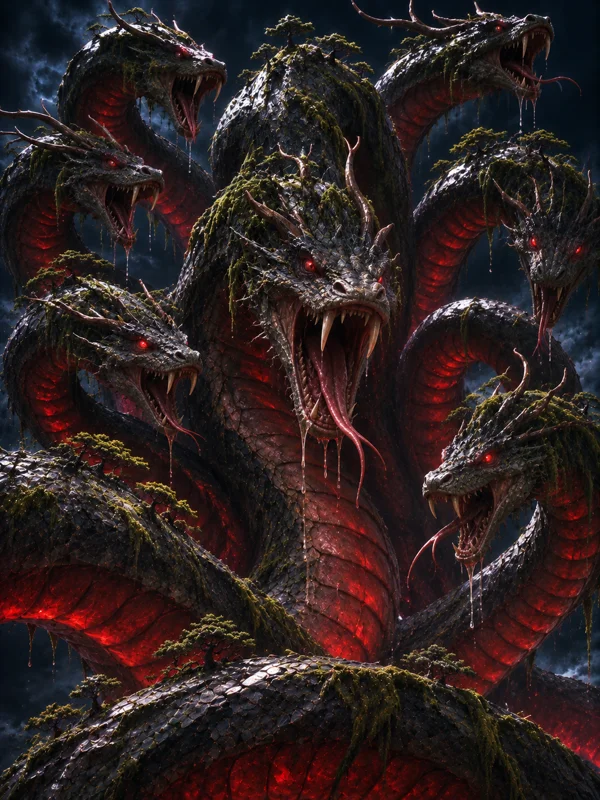
Yamata no Orochi
The eight-headed serpent
“Eight heads, eight tails, eight valleys long”
AT A GLANCE
- JAPANESE
- 八岐大蛇 (Yamata no Orochi)
- DOMAIN
- Floods, devouring, the river Hi
- PARENTS
- Unknown
- SYMBOLS
- Eight heads and eight tails, red eyes, the sword in its tail
- HOME
- The upper river Hi in Izumo
KEY MYTH
The Kojiki says its eyes were as red as winter cherries, cypress and cedar grew on its back, and its body stretched across eight valleys and eight hills. Every year it came to eat one of the daughters of an old couple in Izumo, until Susanoo got it drunk on eight vats of sake and slew it.
TITLES AND EPITHETS
Yamata no Orochi
“Eight-forked giant serpent”
Koshi no Yamata no Orochi
“The eight-forked serpent of Koshi”, after the land it came from
STORY
The monster of Koshi
Every year the serpent came from Koshi to the upper river Hi in Izumo to eat one of the daughters of the old couple Ashinazuchi and Tenazuchi.
Its body
The Kojiki describes eyes as red as winter cherries, eight heads and eight tails, moss, cypress and cedar growing on its body, a length spanning eight valleys and eight hills, and a belly always dripping with blood.
The last daughter
Seven daughters had been eaten. When Susanoo arrived, the parents were weeping over the last, Kushinada.
Eight vats of sake
Susanoo had a fence built with eight gates, and at each gate a vat of sake brewed eight times over. The serpent came, dipped a head into each vat, drank, and fell asleep.
Cut to pieces
Susanoo hacked it apart until the river Hi ran with blood. When his sword chipped on the middle tail, he cut it open and found a great sword inside: Kusanagi.
POWERS
Eight heads
Eight mouths to devour and eight pairs of burning eyes.
Colossal size
Its body stretched over eight valleys and eight hills.
The hidden sword
A divine sword lay in its tail, later one of Japan's three imperial treasures.
LEGACY TODAY
Kagura
The Orochi dance of Iwami kagura, with huge serpent costumes and fireworks, is one of the most popular folk performances in western Japan.
The river and the iron
Many read the serpent as the flooding river Hi and its red belly as the iron sand of Izumo, a centre of ancient iron-working.
Games and film
Orochi appears as a villain from the 1959 film The Three Treasures to the video game Ōkami.
DID YOU KNOW
The sake Susanoo brewed is called yashiori, “eight-times-brewed”, the strongest the gods could make.
In old Japanese, eight often simply means “very many”, so its eight heads also suggest something without end.
The Nihon Shoki says the sword was first called Ame-no-Murakumo, “gathering clouds of heaven”, because clouds always hung over the serpent.
ECHOES IN OTHER WORLDS
Tiamat (Mesopotamian), Typhon (Greek), Apophis (Egyptian)
The great serpents of chaos. Each threatens the gods' order and is beaten by a champion: Tiamat by Marduk, Typhon by Zeus, Orochi by Susanoo, Apophis by Ra and Set, though Apophis always returns.