Yamato Takeru
Legendary prince and hero
“Yamato, the finest of lands”
AT A GLANCE
- JAPANESE
- 日本武尊 (Yamato Takeru-no-Mikoto)
- DOMAIN
- War, courage, cunning
- PARENTS
- Emperor Keikō
- SYMBOLS
- The sword Kusanagi, a fire-striker, a white bird
- HOME
- Yamato
KEY MYTH
A prince so violent his father sent him away to fight, Yamato Takeru killed the Kumaso rebels disguised as a girl, escaped a burning field by cutting the grass with Susanoo's sword, and lost his wife to the sea god. He died after fighting the god of Mount Ibuki without his sword, and flew away as a white bird.
TITLES AND EPITHETS
Ousu-no-Mikoto
His name as a boy, “the little mortar”
Yamato Takeru
“The brave one of Yamato”, a name given to him by a dying enemy
STORY
A dangerous son
In the Kojiki the young prince Ousu killed his own elder brother for failing to come to meals. Frightened of his son's violence, Emperor Keikō sent him far west to kill the Kumaso brothers, rebels no army had beaten.
The girl at the feast
Ousu let down his hair, dressed in clothes from his aunt and slipped into the Kumaso feast disguised as a young woman. When the brothers were drunk he drew a hidden sword and killed them. The dying younger brother gave him the name Yamato Takeru.
The burning field
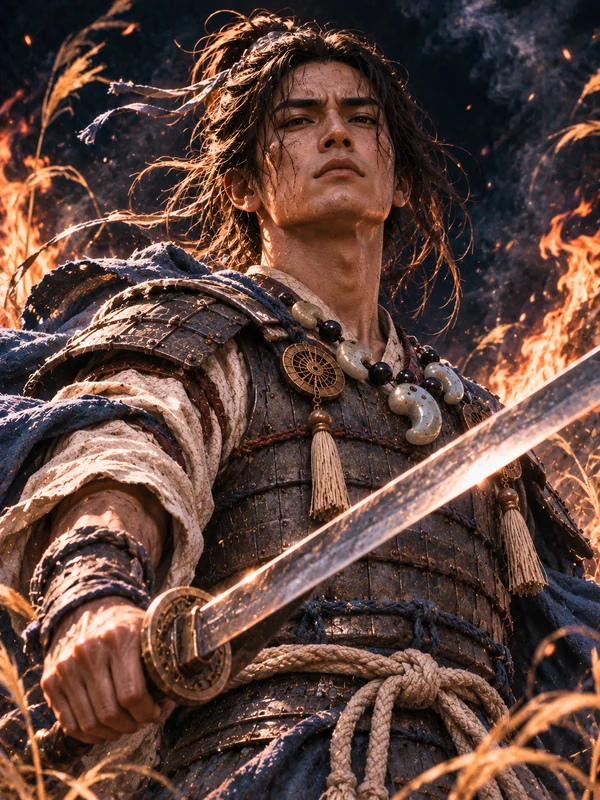
Sent straight away to the east, he visited his aunt Yamato-hime, priestess at Ise, who gave him Susanoo's sword and a small bag. A local chief lured him onto a plain and set the grass on fire. He cut the grass away with the sword and lit a counter-fire with a fire-striker from the bag, and escaped.
The sacrifice at sea
Crossing a strait, his boat was caught in a storm raised by the sea god. His wife Ototachibana-hime stepped down onto the waves to calm the god, and the sea grew still. Days later her comb washed ashore.
The white bird
Proud of his strength, he left the sword with his wife Miyazu-hime and went to fight the god of Mount Ibuki with bare hands. The god sent freezing hail, and the hero fell sick. He died on the plain of Nobono longing for home, and his spirit flew away as a great white bird.
POWERS
Courage
He walked into enemy halls, burning plains and storms without fear.
Cunning
He won as often by tricks and disguise as by force.
The grass-cutter
He carried Kusanagi, the sword from Orochi's tail.
WORSHIP
Atsuta Shrine, Nagoya
Founded, in tradition, to keep the sword Kusanagi after his death. It is still said to be kept there, unseen.
Ōtori Shrines
Shrines named for the “great bird” across Japan honour him, linked to the white bird his spirit became.
LEGACY TODAY
Kusanagi
The sword's name is explained by his escape from the burning field. It is one of the three Imperial Regalia of Japan.
The tragic hero
His life, brilliant, cruel and cut short, became a model for the Japanese tragic hero.
DID YOU KNOW
His dying poem praising Yamato as the finest of lands is still one of the best-known verses of the Kojiki.
Three tombs called Shiratori, “white bird”, mark the places where his spirit is said to have landed.
In the Kojiki the god of Ibuki appears as a white boar; in the Nihon Shoki as a great serpent.
FAMILY
- Parents
- Emperor Keikō
- Consorts and lovers
- Ototachibana-hime, Miyazu-hime of Owari